Why individuals differ
By UK GCSE Biology · independent study · myAudience
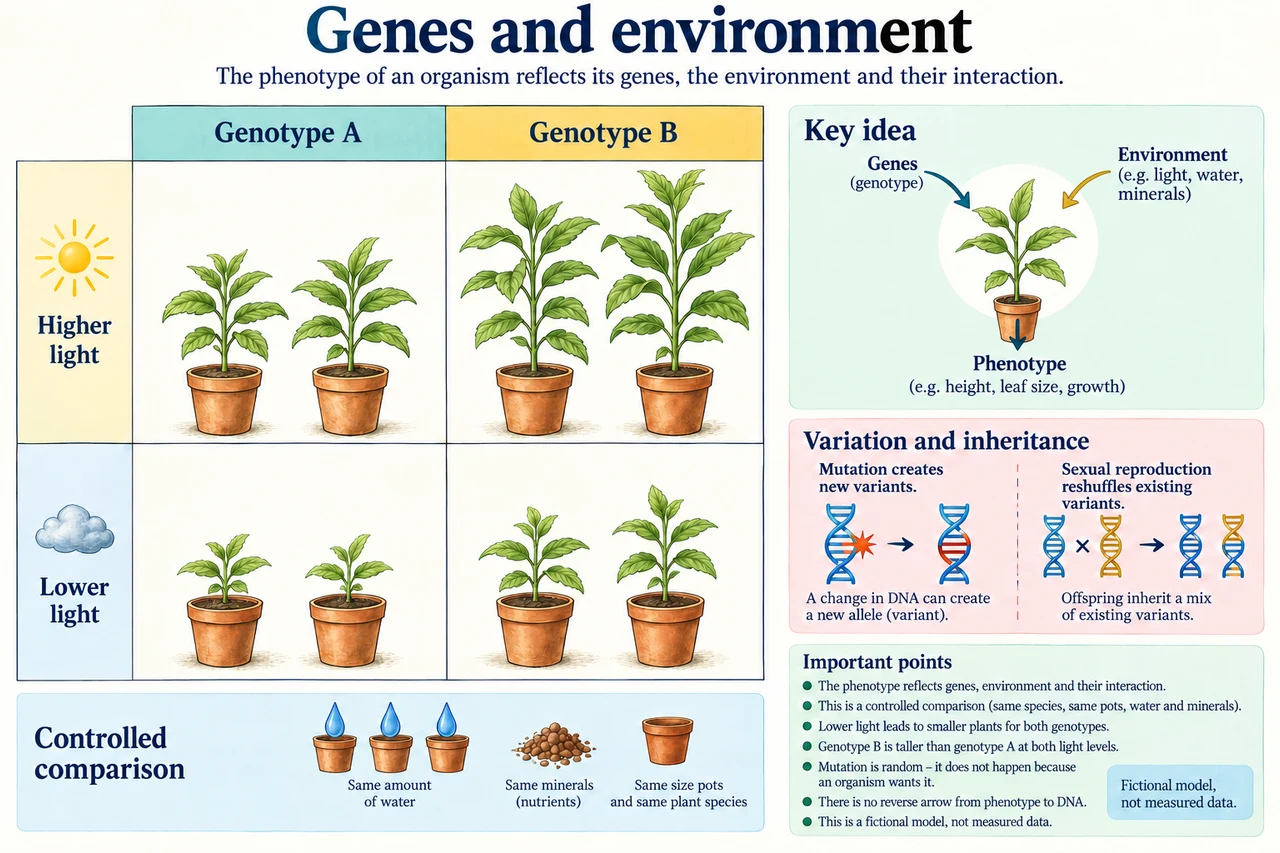
Original myAudience scientific illustration; not a documentary photograph or measured specimen. · Original generated project artwork; source concepts reviewed, no textbook figures copied.
Why individuals differ
Variation means differences between individuals. Genetic differences arise through inherited allele combinations and mutations; environmental differences include factors such as nutrition or light exposure. Many characteristics reflect both types of influence rather than one simple cause.
To investigate an environmental effect, compare suitable organisms under controlled conditions and recognize the limits of the design. Identical genotypes can develop differently in different environments, while similar environments do not remove inherited differences. Explain what was measured and controlled before labeling a whole trait as purely genetic or purely environmental.
A mutation changes DNA, while recombination and fertilisation arrange inherited variants into new combinations. A characteristic can reflect an interaction: a plant genotype may influence potential height, but light, water and minerals affect the height achieved. Most mutations do not produce a detectable change in phenotype in the context considered. A new variant does not arise because an organism deliberately needs it; its effect depends on the sequence and environment.
Worked example: Two genetically matching plants grow to different heights under different light levels. What explanation should be considered?
Their inherited information is similar
Their environments differ
Answer: Light availability could contribute to the height difference.
Check your understanding: Are all differences between individuals caused only by genes?
Answer: No.
Why: Environmental conditions and interactions with genetic information can also affect characteristics.