Changing populations across generations
By UK GCSE Biology · independent study · myAudience
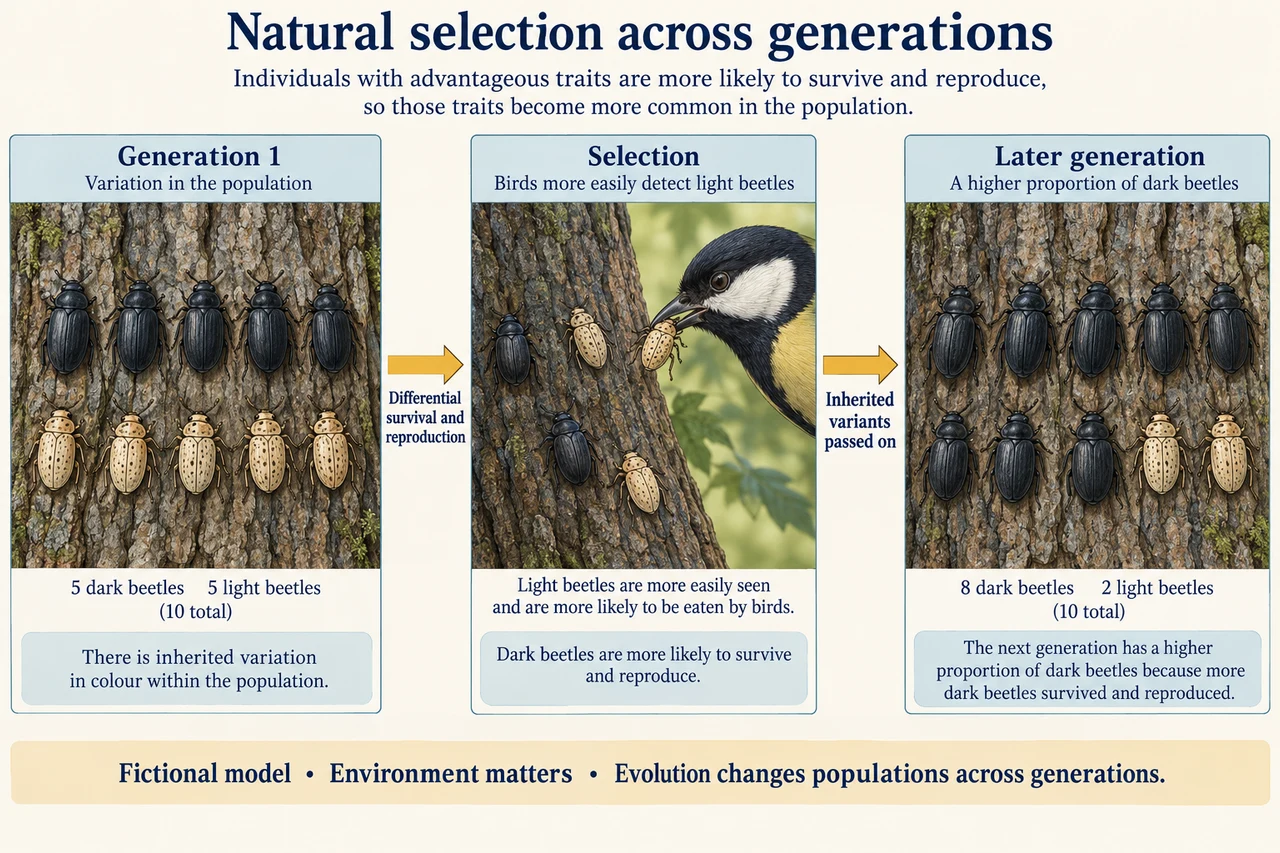
Original myAudience scientific illustration; not a documentary photograph or measured specimen. · Original generated project artwork; source concepts reviewed, no textbook figures copied.
Changing populations across generations
Evolution describes changes in inherited characteristics of populations across generations. Natural selection can occur when individuals vary, some variation is inherited, and particular features affect survival or reproduction. Alleles associated with greater reproductive success can become more frequent under those conditions.
The environment determines which differences are useful, and that can change. A camouflage pattern favorable on one background may be less useful on another. Mutations are not directed toward the outcome an organism needs. Keep the origin of variation separate from selection among existing variants when explaining an evolutionary change.
Selection acts through differences in reproductive success. A useful inherited feature can become more frequent if carriers leave more surviving offspring than alternatives under the same conditions. An individual does not replace its inherited alleles because it tries harder, and a population is not evolving toward a fixed perfect endpoint. The same feature can help in one environment and hinder in another; random events and other evolutionary processes can also affect populations.
Worked example: A heritable camouflage pattern reduces predation. Explain a possible change over generations.
Better-camouflaged individuals may leave more offspring
Offspring can inherit the relevant alleles
Answer: Those alleles may become more frequent in the population.
Check your understanding: Does natural selection require inherited variation?
Answer: Yes, for the described evolutionary change.
Why: Without inheritance, a survival difference would not necessarily shift the next generation’s allele frequencies.