Breeding for chosen traits
By UK GCSE Biology · independent study · myAudience
Original myAudience scientific illustration; not a documentary photograph or measured specimen. · Original generated project artwork; source concepts reviewed, no textbook figures copied.
Breeding for chosen traits
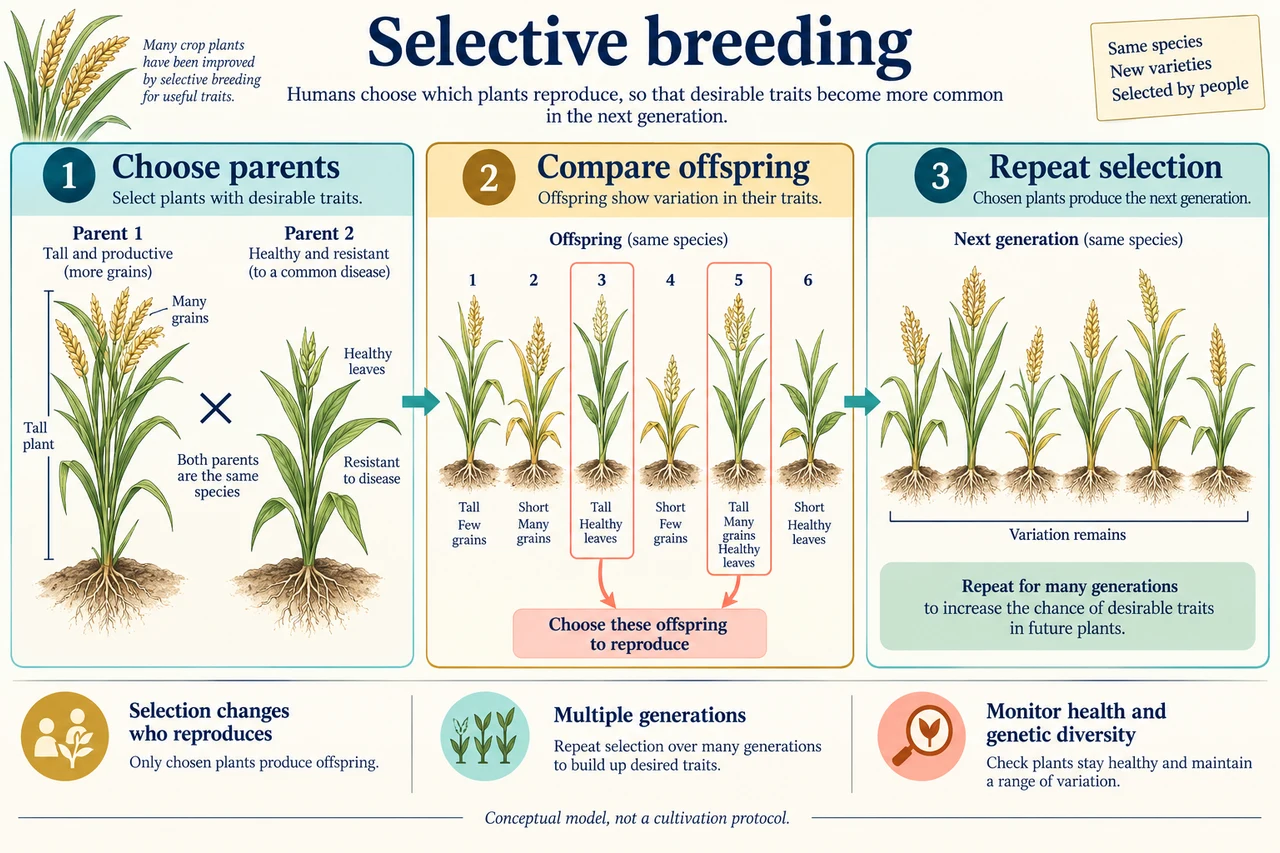
Selective breeding changes which individuals become reproductive parents. A breeder defines an inherited characteristic, chooses suitable parents, compares offspring and repeats selection across generations. It can aim at crop disease resistance, useful animal yields or an ornamental feature; it does not directly insert a selected DNA sequence.
Consider a crop with two useful features: a high-yield parent lacks resistance to a disease, while a resistant parent has a lower yield. Their offspring vary, so choosing offspring that combine the desired features requires observations over later generations. A parent’s appearance alone cannot guarantee every offspring’s combination. Narrowing the breeding group may increase shared harmful recessive alleles or reduce resilience, which makes diversity and health separate selection criteria.
Worked example: Why could repeatedly breeding closely related animals create a problem?
Related parents can share harmful recessive alleles
Their offspring have a greater chance of receiving matching copies
Answer: Inbreeding can increase expression of some inherited disorders.
Check your understanding: Is selective breeding the same as inserting a gene with a laboratory vector?
Answer: No.
Why: It chooses reproductive parents rather than directly transferring a chosen DNA sequence by that method.