Changing genes deliberately
By UK GCSE Biology · independent study · myAudience
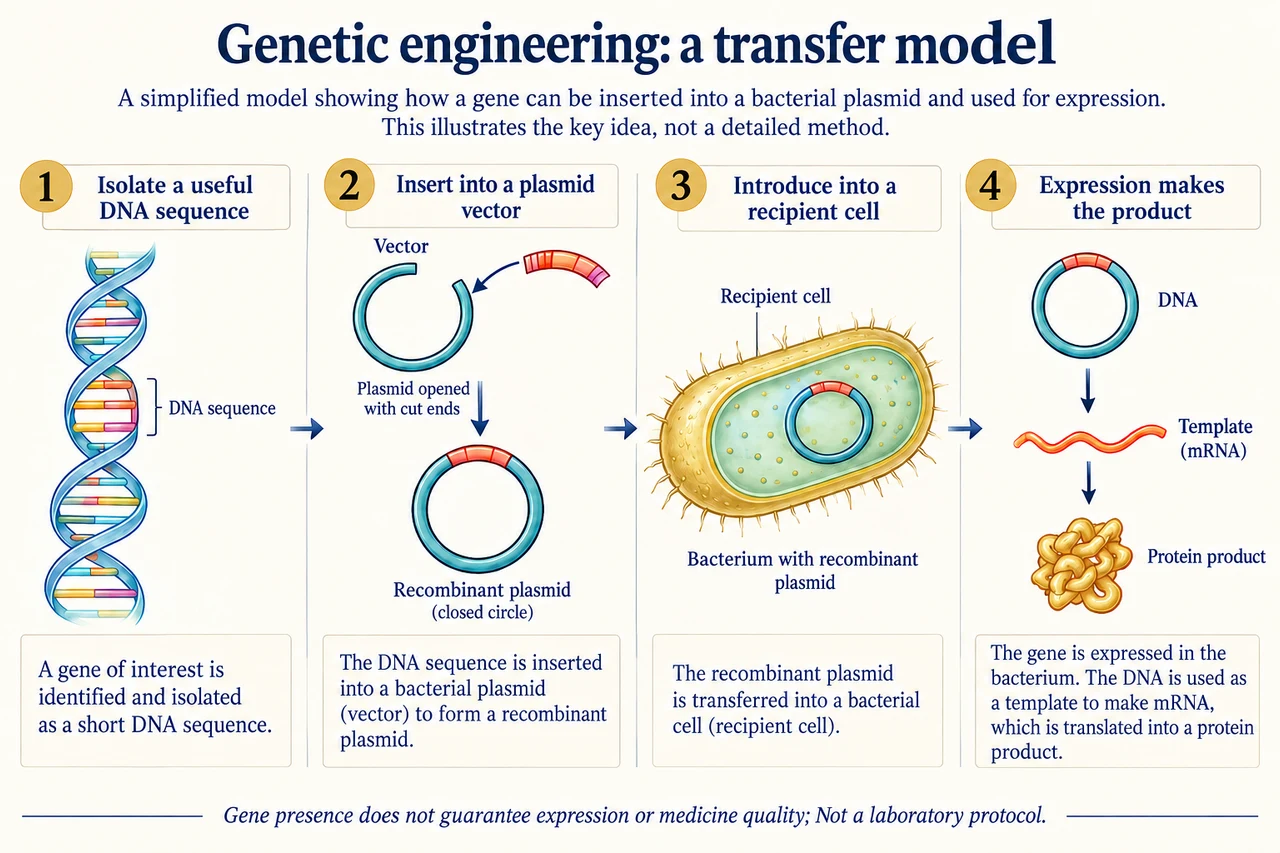
Original myAudience scientific illustration; not a documentary photograph or measured specimen. · Original generated project artwork; source concepts reviewed, no textbook figures copied.
Changing genes deliberately
Genetic engineering deliberately alters genetic information. In the higher-tier transfer model, a useful DNA sequence is isolated and a vector such as a plasmid carries it into recipient cells. The intended product depends on those cells using the sequence; transferring DNA is not equivalent to transferring a whole organ.
Engineered microorganisms can produce an insulin-related protein rather than performing all the functions of a human pancreas. Obtaining a useful medicine also requires evidence about the product and its manufacture; detecting the transferred gene alone does not establish clinical suitability. A crop modification similarly concerns a specified trait, such as resistance, whose effects must be evaluated in the relevant environment rather than assuming all engineered organisms have identical benefits or risks.
Worked example: Why must an inserted insulin-related gene be expressed to produce insulin?
Possessing DNA is not the same as using its information
The cell must make the corresponding product
Answer: Successful expression is required for production.
Check your understanding: Does every genetic modification transfer DNA between different species?
Answer: No.
Why: Genetic information can be changed in different ways; interspecies transfer is one example.