Producing genetically matching organisms
By UK GCSE Biology · independent study · myAudience
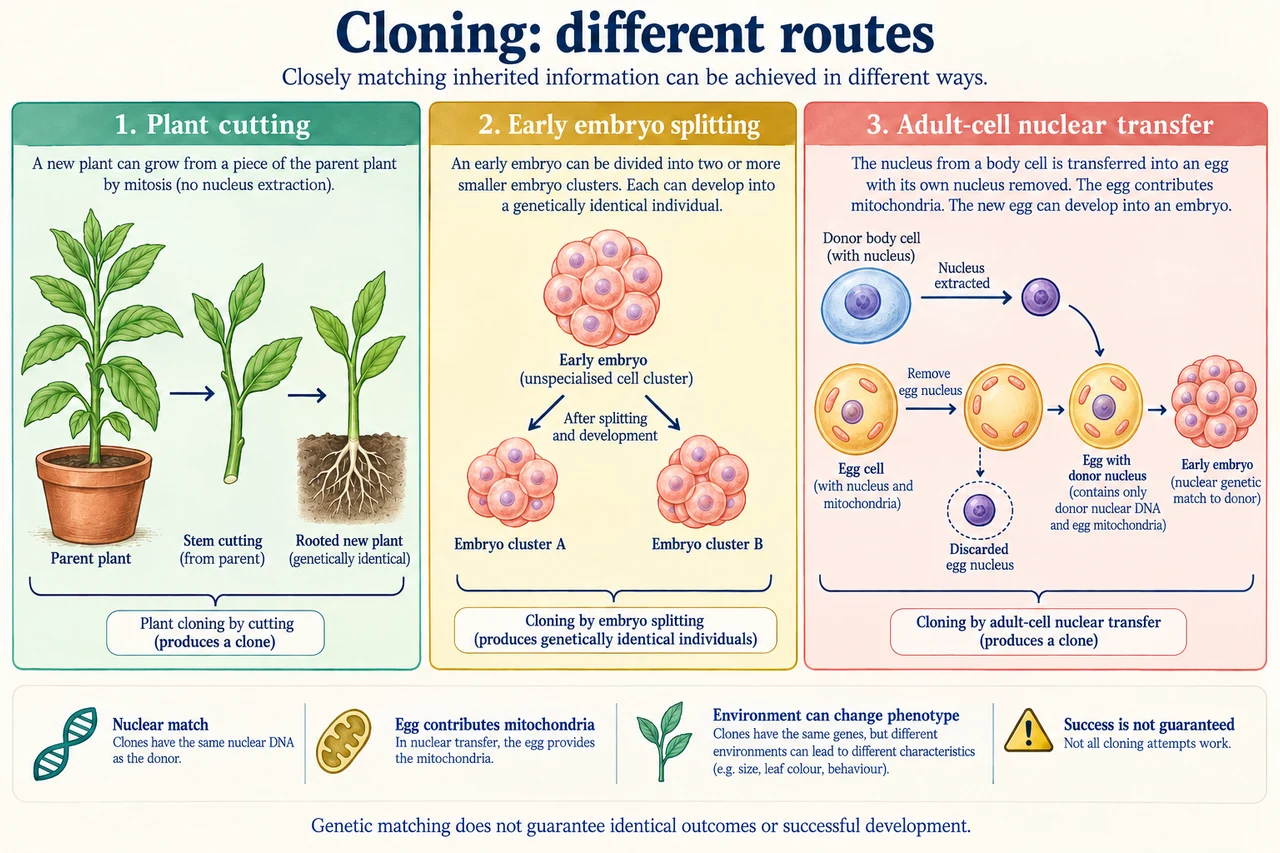
Original myAudience scientific illustration; not a documentary photograph or measured specimen. · Original generated project artwork; source concepts reviewed, no textbook figures copied.
Producing genetically matching organisms
Cloning produces organisms with closely matching inherited information. Plant cuttings and tissue culture can propagate useful varieties. In animals, embryo splitting and transfer of a body-cell nucleus into an egg whose nucleus has been removed illustrate different cloning approaches.
A genetic match is not a guarantee of an identical life history or every observable trait. Environment and development can produce differences. Cloning raises questions about genetic diversity, welfare, efficiency and purpose. Compare the particular method and evidence, while separating a conceptual explanation from a safe practical protocol or a promise of successful reproduction.
Plant cuttings and tissue culture preserve useful genetic combinations, while early embryo splitting gives offspring derived from the same embryo. In adult-cell nuclear transfer, an egg receives a donor body-cell nucleus after its own nucleus is removed, and an embryo may later be transferred to a uterus. The donor’s nuclear information is the main genetic match; this does not imply identical experiences, guaranteed success or that all cellular DNA comes from the same donor.
Worked example: Why might cloned plants grown in different conditions have different sizes?
Their genetic information is closely matched
Growth also responds to environmental conditions
Answer: Genetic similarity does not eliminate environmental variation.
Check your understanding: Is ordinary fertilization a cloning process?
Answer: No.
Why: It combines genetic information from gametes rather than reproducing one donor’s nuclear genotype.