How evolutionary explanations developed
By UK GCSE Biology · independent study · myAudience
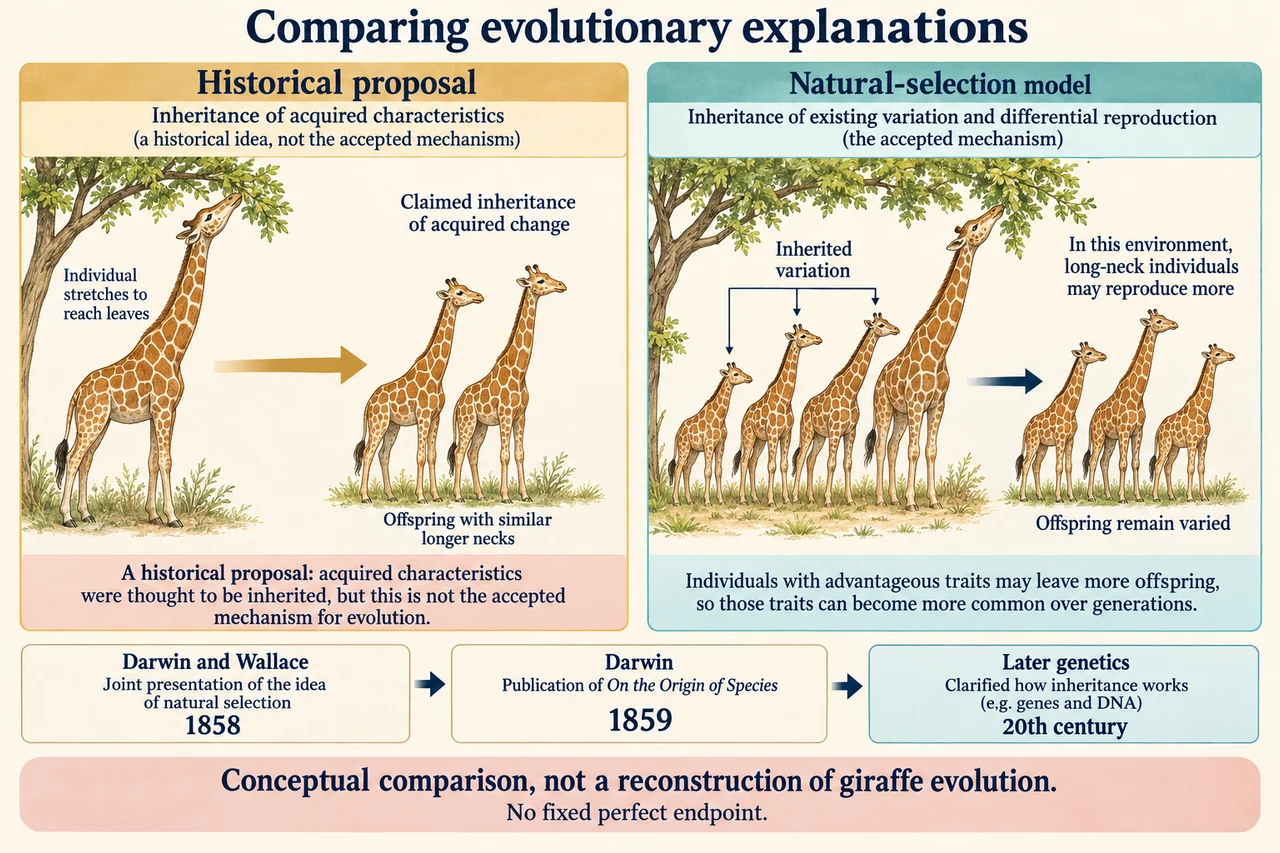
Original myAudience scientific illustration; not a documentary photograph or measured specimen. · Original generated project artwork; source concepts reviewed, no textbook figures copied.
How evolutionary explanations developed
Darwin and Wallace independently developed natural-selection explanations, presented jointly in 1858. Inherited variation can lead to differences in survival and reproduction, changing populations over generations. Lamarck’s explanation instead included inheritance of characteristics acquired during life. The familiar neck-stretching illustration contrasts these mechanisms; it is not a detailed reconstruction of giraffe history.
The early authors lacked the later chromosome and DNA account of inheritance. Genetics helped connect inherited variation with selection, while observations from different fields tested the predictions. Historical acceptance was also influenced by social and religious debate. Scientific support rests on explanatory evidence, not the proposer’s fame, an idea’s age or its popularity.
Worked example: How does selection differ from the claim that repeated stretching makes offspring inherit a longer neck?
Selection starts with inherited variation among individuals
Individuals with particular variants may leave more offspring
Answer: It does not require offspring to inherit a parent’s acquired stretching.
Check your understanding: Did Darwin need modern DNA sequencing to propose natural selection?
Answer: No.
Why: The historical proposal preceded that technology, although later genetic evidence strengthened understanding.