How new species arise
By UK GCSE Biology · independent study · myAudience
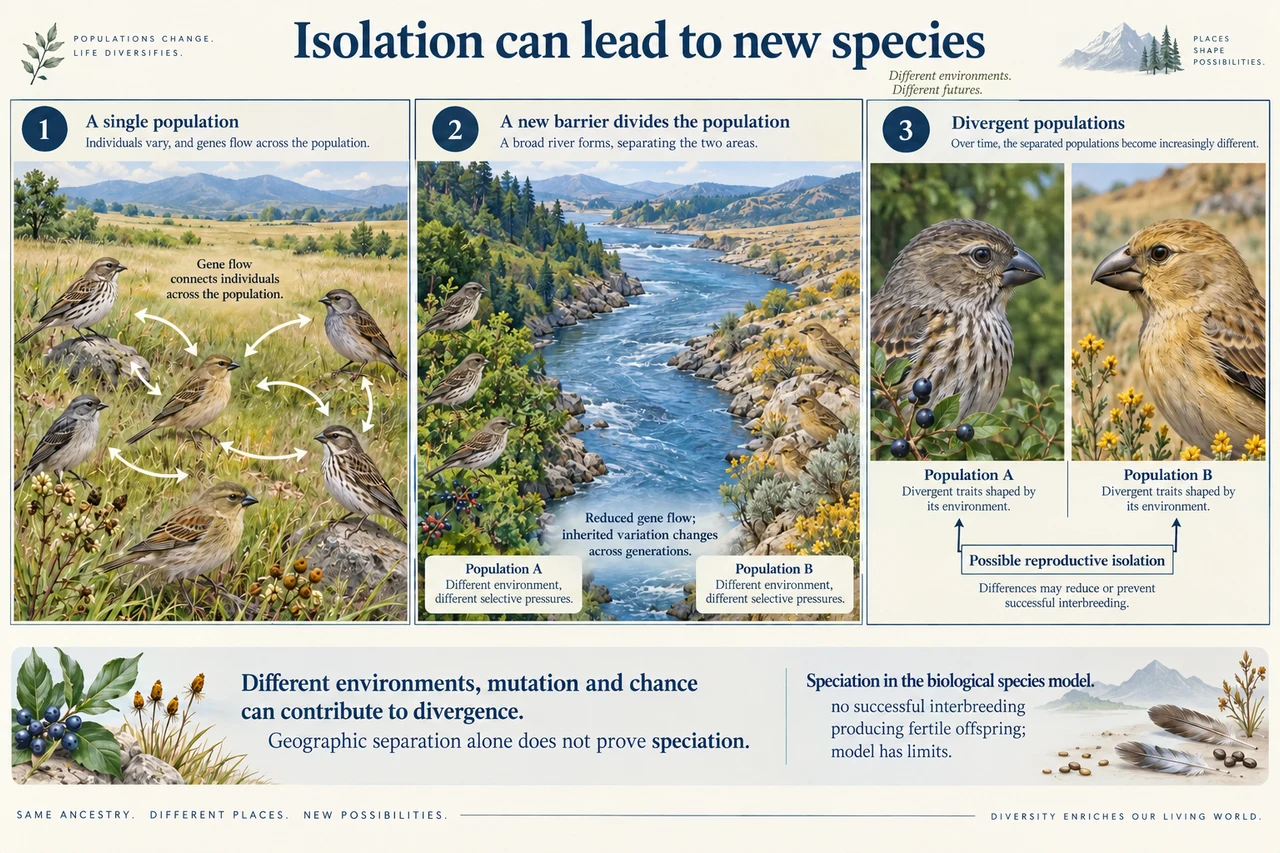
Original myAudience scientific illustration; not a documentary photograph or measured specimen. · Original generated project artwork; source concepts reviewed, no textbook figures copied.
How new species arise
Geographic isolation can reduce gene flow between populations. Different selection pressures, mutations and chance changes can then lead to inherited divergence. In the biological-species model, speciation has occurred when the groups can no longer successfully interbreed to produce fertile offspring. A barrier is a starting condition, not an instant declaration of a new species.
An explanation needs a sequence linking isolation, inherited differences and reproductive isolation. Visible differences alone do not establish the final step. Other speciation mechanisms exist, and no fixed timetable applies to every lineage. The interbreeding model is useful for many sexually reproducing organisms, but cannot be applied unchanged to every fossil or asexual lineage.
Worked example: An island population is isolated from the mainland. Why might their inherited features diverge?
Gene flow is reduced
Different environments and genetic changes can affect each group
Answer: Their allele frequencies can change independently over generations.
Check your understanding: Does geographic separation instantly create a new species?
Answer: No.
Why: Isolation provides conditions for divergence, but speciation requires further reproductive separation.