Testing evolutionary explanations
By UK GCSE Biology · independent study · myAudience
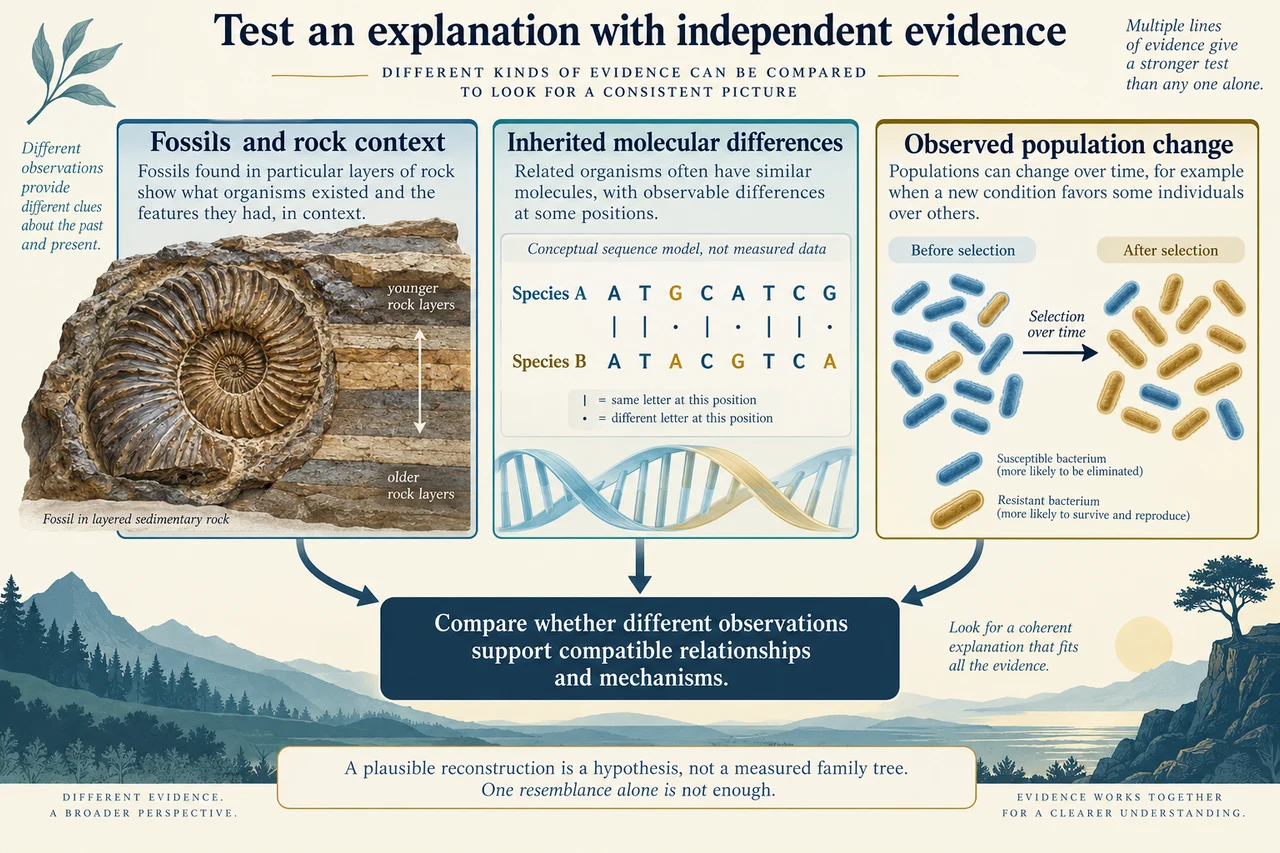
Original myAudience scientific illustration; not a documentary photograph or measured specimen. · Original generated project artwork; source concepts reviewed, no textbook figures copied.
Testing evolutionary explanations
Fossils provide evidence about past organisms; anatomy and molecular sequences help compare relationships; observed antibiotic resistance shows inherited population change over shorter periods. These lines answer different questions. A useful evolutionary account explains their agreement through mechanisms rather than relying on resemblance in one picture.
A shared anatomical feature may reflect common ancestry or another explanation, so genetic and geological context can help test competing accounts. Uncertainty about one ancestral branch does not erase independent evidence for evolution. Equally, a plausible reconstruction cannot establish a precise family tree without supporting observations. Revise the specific claim as evidence improves.
Worked example: Why can agreement between fossil and genetic evidence strengthen an explanation?
The evidence comes from different kinds of observation
Both can support compatible relationships
Answer: Independent agreement reduces reliance on one possible source of error.
Check your understanding: Must an evolutionary explanation rely only on fossils?
Answer: No.
Why: Genetics, anatomy and observed population changes provide other forms of evidence.