Traces of past organisms
By UK GCSE Biology · independent study · myAudience
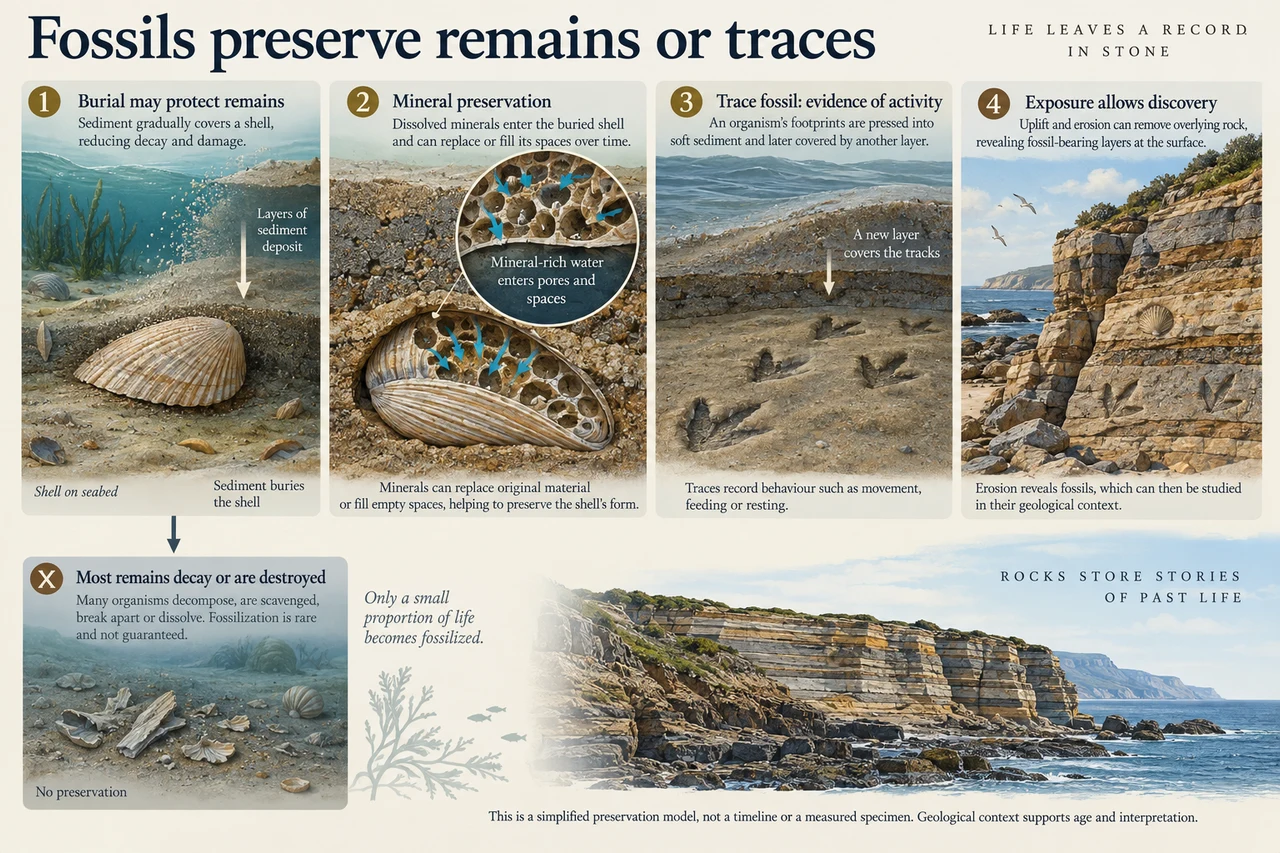
Original myAudience scientific illustration; not a documentary photograph or measured specimen. · Original generated project artwork; source concepts reviewed, no textbook figures copied.
Traces of past organisms
Fossils are remains or traces of past organisms. Hard parts may survive and become mineralised; footprints record activity; rapid burial or unusual conditions can preserve material otherwise lost. Most organisms leave no fossil, and later erosion, heating or deformation can destroy or conceal evidence. Preservation is therefore a filter rather than a complete census.
A fossil’s age and interpretation depend on its geological context. Preserved structures can support conclusions about form, while behaviour or reconstructed soft tissue may require additional evidence. A missing intermediate in a collection can reflect preservation and sampling limits rather than a sudden biological jump in one generation. Label the observed feature separately from a proposed reconstruction.
Worked example: Why might soft-bodied organisms be underrepresented in fossil collections?
Soft tissues often decay without preservation
Fossil formation requires suitable conditions
Answer: Their absence can reflect preservation bias rather than lack of past existence.
Check your understanding: Is a footprint a possible fossil trace?
Answer: Yes.
Why: A fossil can preserve evidence of activity rather than the organism’s body.