When species disappear
By UK GCSE Biology · independent study · myAudience
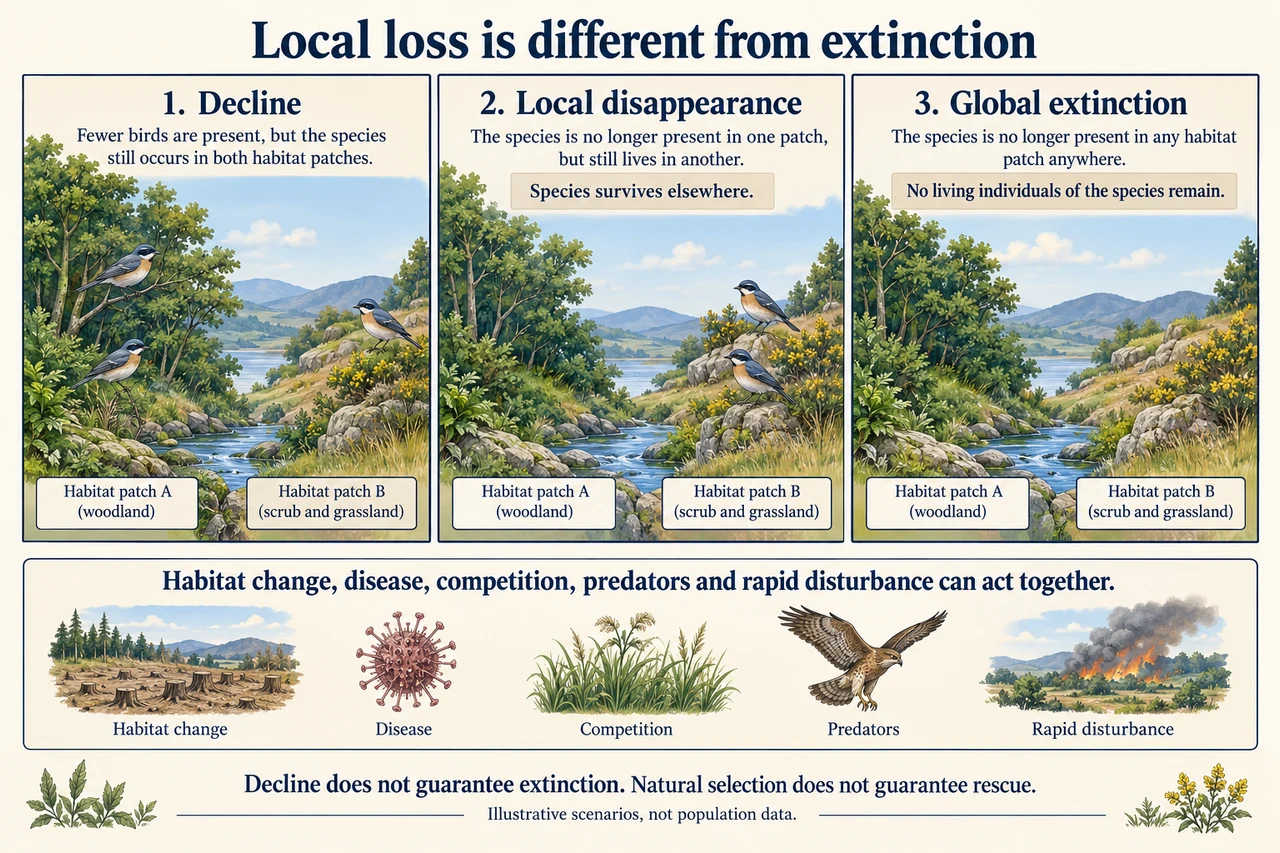
Original myAudience scientific illustration; not a documentary photograph or measured specimen. · Original generated project artwork; source concepts reviewed, no textbook figures copied.
When species disappear
Extinction occurs when a species has no surviving individuals. Environmental change, new competitors or predators, disease and catastrophic events can contribute. A species may be especially vulnerable if it cannot move, adapt or reproduce quickly enough under changed conditions.
A species may fail to adapt if change is too rapid or suitable variation and opportunities are absent. Natural selection does not guarantee that every threatened lineage survives. Evaluate evidence for particular causes rather than assuming a single factor explains all extinctions, and separate a local disappearance from loss of the entire species.
A decline can become self-reinforcing when remaining individuals struggle to find mates or when diversity falls, although no single population size guarantees extinction. Habitat changes, predators, diseases and competition can act together. Rapid change may outpace reproduction or dispersal, and a beneficial variant is not guaranteed to appear in time. Distinguish global extinction from local loss and identify the evidence supporting a proposed cause rather than assigning every loss to one universal pressure.
Worked example: A species disappears from one island but remains on another. Has it become globally extinct?
Identify the geographic scale
Surviving individuals still exist elsewhere
Answer: No; the island loss is local disappearance, not global extinction.
Check your understanding: Can several pressures contribute to extinction together?
Answer: Yes.
Why: Combined changes can reduce survival and reproduction beyond what any single pressure would cause.