Organising life's diversity
By UK GCSE Biology · independent study · myAudience
Original myAudience scientific illustration; not a documentary photograph or measured specimen. · Original generated project artwork; no textbook figure copied.
Organising life's diversity
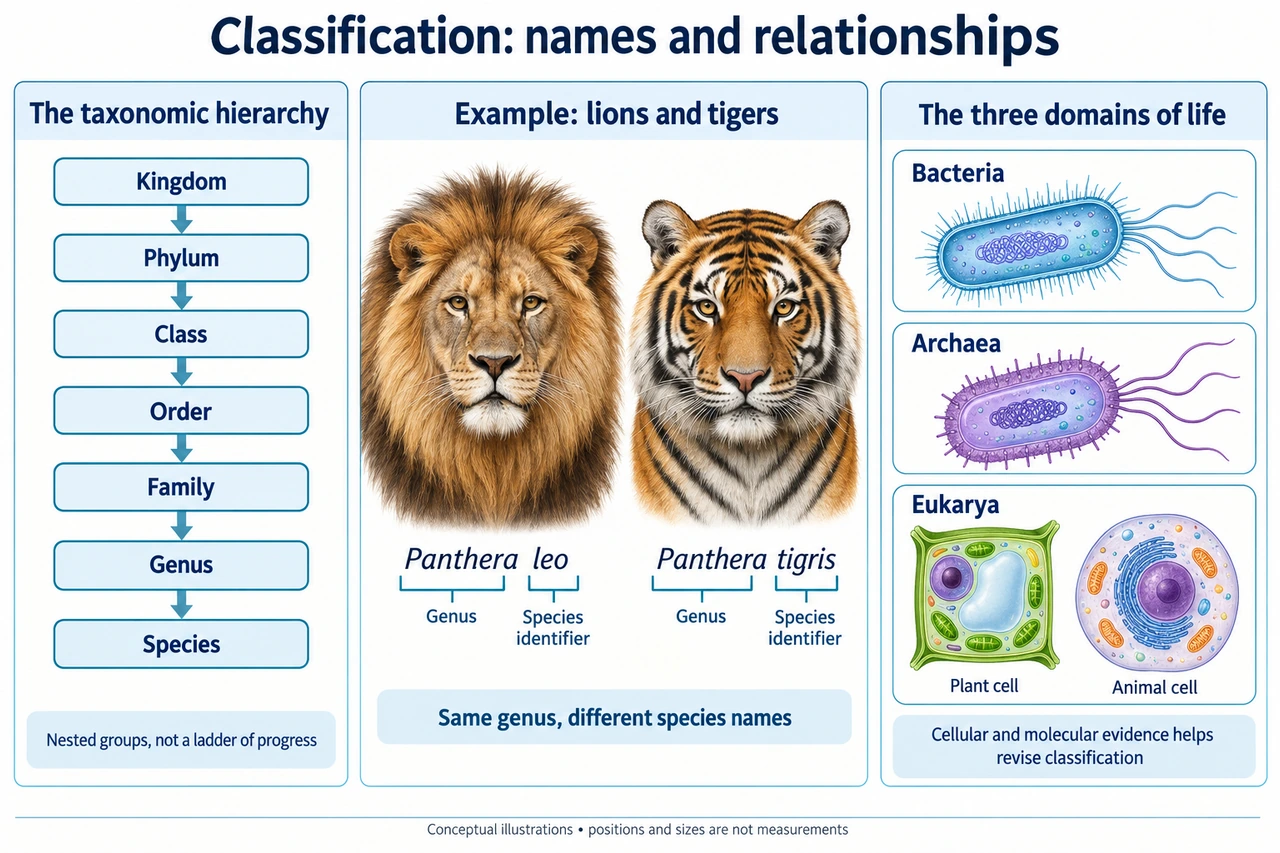
Classification organizes organisms into groups reflecting shared features and relationships. The traditional hierarchy includes kingdom, phylum, class, order, family, genus and species. A scientific species name combines genus and a species identifier, helping avoid ambiguous common names.
The three-domain model separates Bacteria, Archaea and Eukarya using evidence including cellular and molecular differences. Evolutionary trees depict hypotheses of common ancestry; nearby tips are not automatically direct ancestor and descendant. Compare branch relationships and evidence rather than reading the left-to-right position of a drawing as a ladder of progress.
The binomial name contains a genus followed by a species identifier; capitalisation and both parts help distinguish it from a common name. Molecular evidence helped separate Bacteria, Archaea and Eukarya into three domains rather than putting every microscopic organism into one group. In an evolutionary tree, a branching point represents a proposed common ancestor. Rotating branches around that point changes the drawing’s arrangement without changing the inferred relationships.
Worked example: Two organisms share a genus but have different species identifiers. Are their full scientific names identical?
A name includes both genus and species identifier
The second element differs
Answer: No; they are distinct named species within the same genus.
Check your understanding: Does a branching tree mean modern organisms are all ancestors of one another?
Answer: No.
Why: Branches usually represent descent from shared ancestors, not direct descent from every living species shown.