Networks of living populations
By UK GCSE Biology · independent study · myAudience
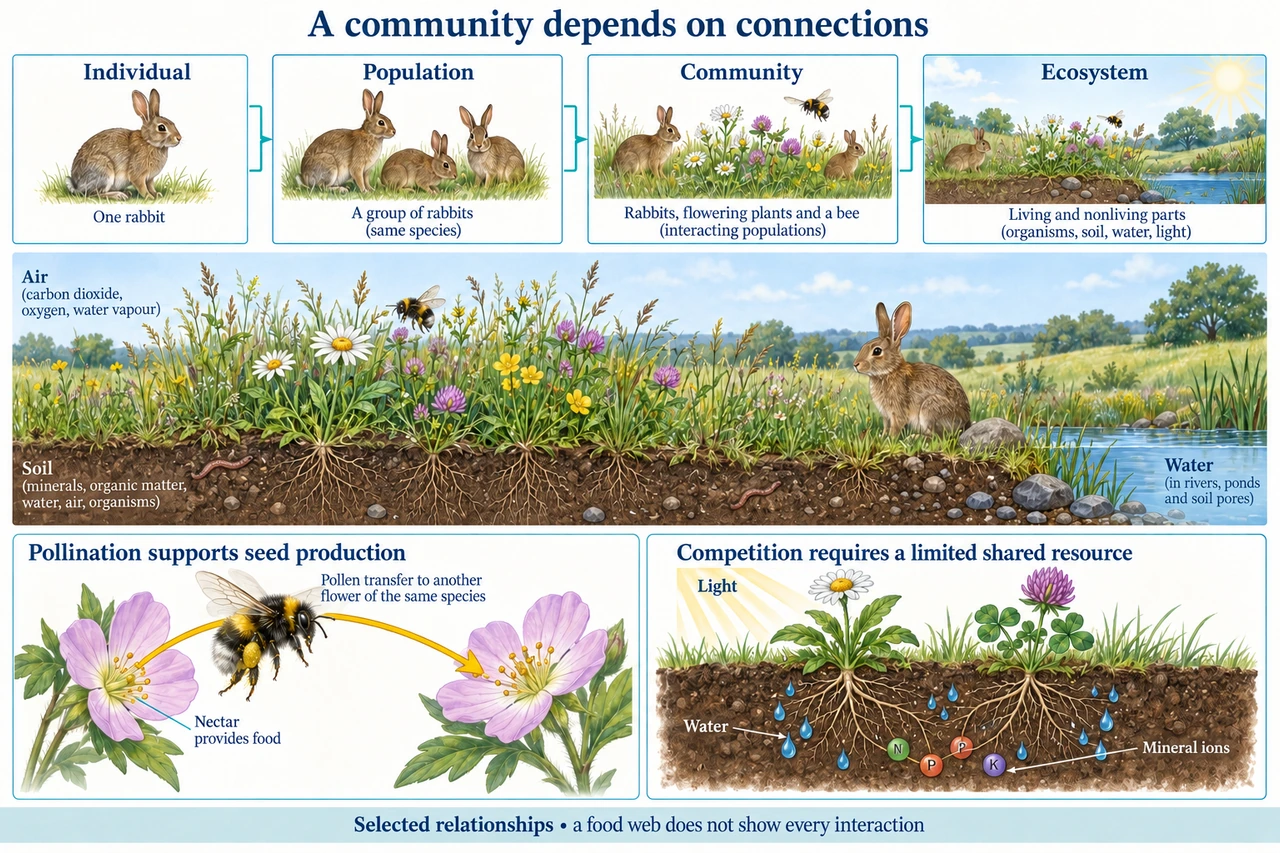
Original myAudience scientific illustration; not a documentary photograph or measured specimen. · Original generated project artwork; no textbook figure copied.
Networks of living populations
A population contains members of one species in an area. A community contains interacting populations, and an ecosystem includes the community and its nonliving surroundings. Organisms depend on resources and on other organisms through relationships such as feeding and pollination.
Competition occurs when resources are limited. Plants can compete for light, water, space and mineral ions, while animals can compete for food, territory or mates. A food web shows some feeding connections but not every interaction. State the resource and mechanism before claiming that any two neighboring organisms must be competitors.
A habitat is the place an organism lives; a population is members of one species in a defined area. Interdependence includes more than feeding: shelter, pollination and seed dispersal can connect populations. Competition requires overlapping demand for a limited resource. Two plants growing together might compete for water but still differ in rooting depth or seasonal activity, so proximity alone is not evidence that every resource is shared.
Worked example: How might loss of a pollinating insect affect a plant population?
The insect contributes to reproductive pollination
Fewer successful pollination events may reduce seed production
Answer: The plant population could be affected through interdependence.
Check your understanding: Is an ecosystem only the living organisms in an area?
Answer: No.
Why: Nonliving conditions are also part of the ecosystem.