Nonliving influences on ecosystems
By UK GCSE Biology · independent study · myAudience
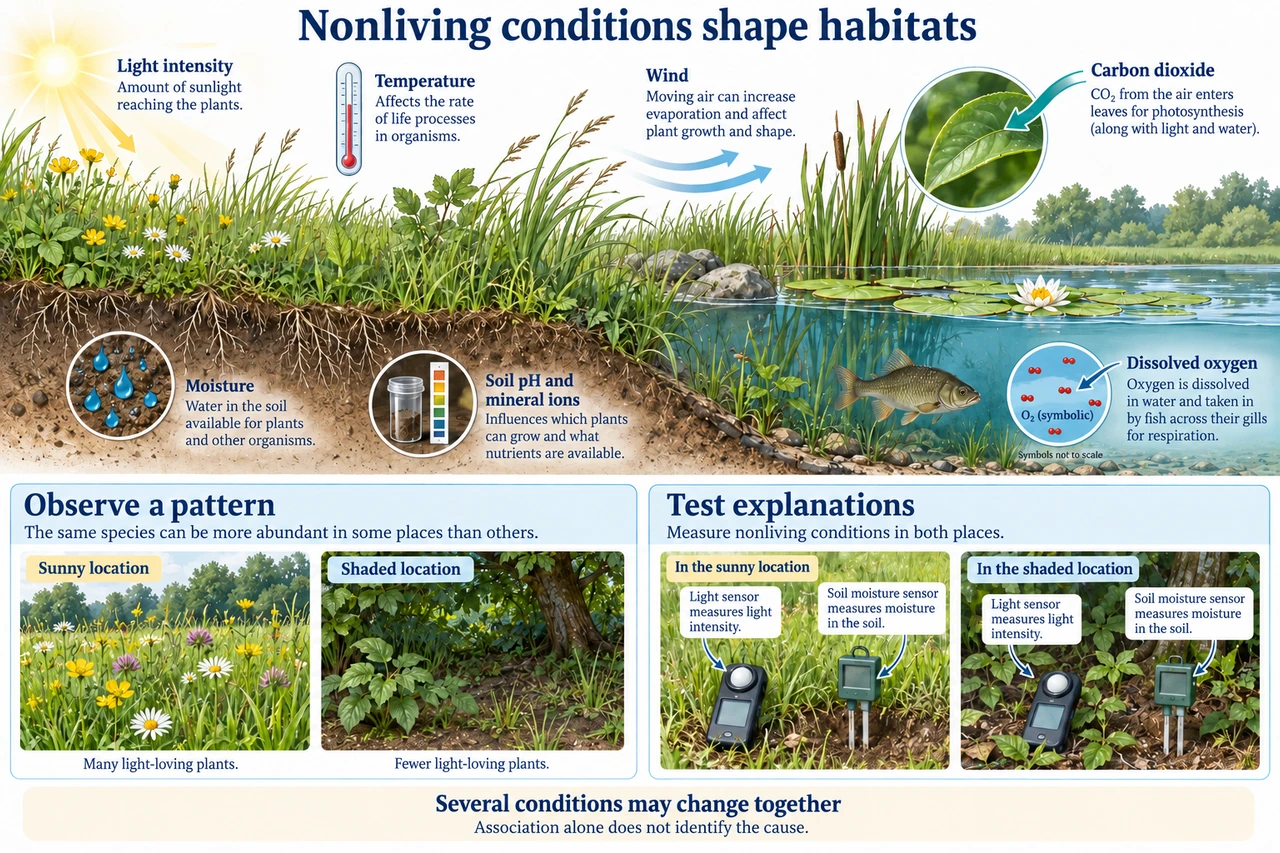
Original myAudience scientific illustration; not a documentary photograph or measured specimen. · Original generated project artwork; no textbook figure copied.
Nonliving influences on ecosystems
Abiotic factors are nonliving environmental influences, including light, temperature, water availability and soil conditions. They can affect growth, survival and distribution. Different species tolerate different ranges, so one condition may favor one organism but limit another.
A distribution pattern is an observation, not automatic proof of its cause. If plants are sparse on one slope, moisture, soil, grazing and light might all differ. Use appropriate sampling and measurements to compare explanations. A controlled model can test one factor, while field observations must acknowledge multiple conditions changing together.
Soil pH and mineral content influence plants, while oxygen availability can constrain aquatic animals. Wind affects water loss and dispersal; moisture alters plant growth and microbial activity. A field comparison should record units and measurement times because temperature or light can change within a day. If abundance changes along a slope, measure the proposed abiotic factor rather than assuming the slope itself identifies the cause.
Worked example: A plant occurs more often in bright sites than shaded sites. What further question would strengthen the investigation?
Light differs between the sites
Other conditions may also differ
Answer: Check whether water, soil or sampling differences could explain the pattern.
Check your understanding: Is temperature a biotic factor?
Answer: No; it is abiotic.
Why: It is a nonliving environmental condition rather than an influence from another organism.