Features aiding survival
By UK GCSE Biology · independent study · myAudience
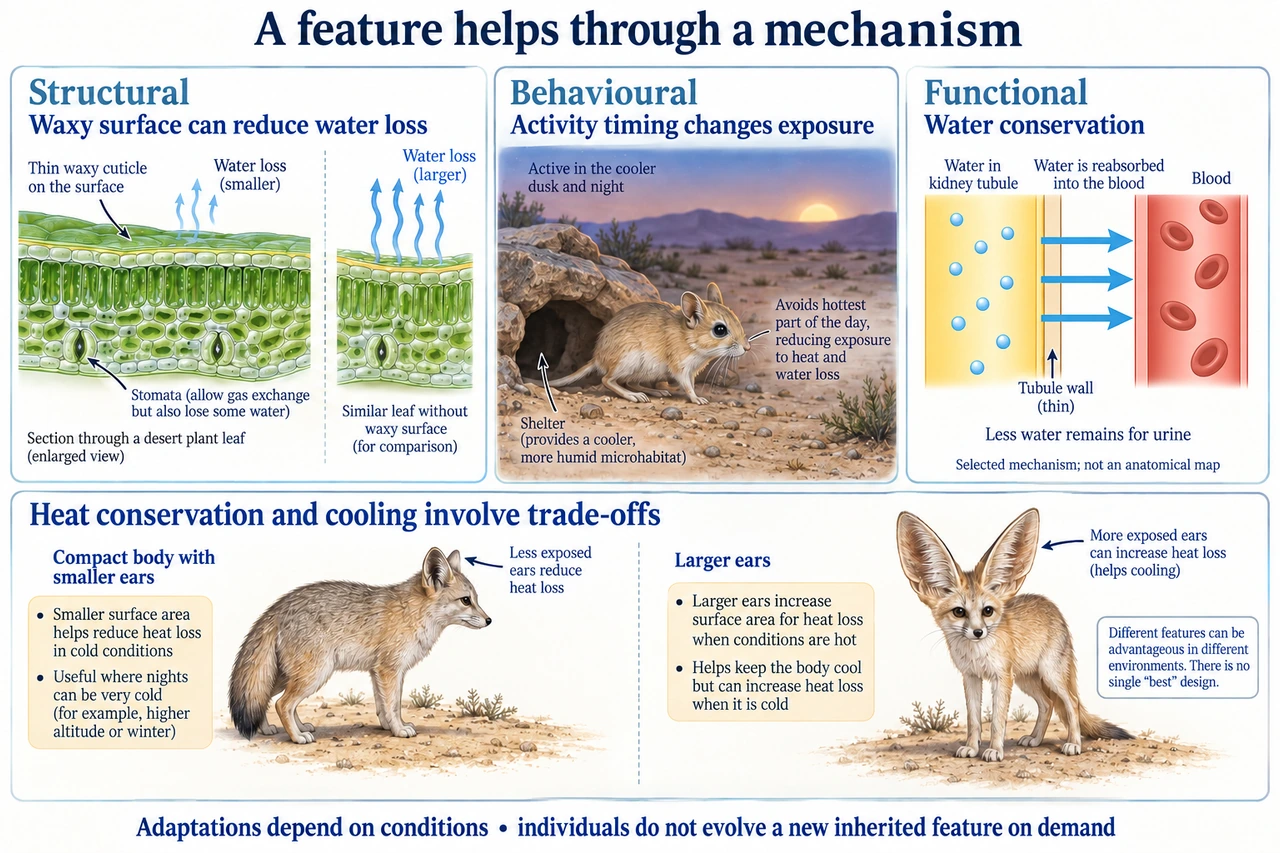
Original myAudience scientific illustration; not a documentary photograph or measured specimen. · Original generated project artwork; no textbook figure copied.
Features aiding survival
Adaptations are features that can help organisms survive and reproduce in particular conditions. They can be structural, behavioral or functional. A thick insulating layer affects heat transfer, while activity at night can reduce exposure to daytime heat.
Extremophiles tolerate conditions such as high temperature or unusual chemical environments through particular adaptations. Explaining a feature should link it to a relevant process, not simply say the organism is adapted because it survives. Natural selection acts across generations; individual behavioral responses and population-level evolutionary adaptations are related but distinct.
Structural adaptations include body coverings or leaf shape; behavioural adaptations include timing of activity, and functional adaptations involve processes such as regulating water loss. A low surface-area-to-volume ratio can reduce heat exchange, while a large exposed area can support cooling in a suitable environment. Adaptations reflect particular trade-offs: conserving heat in a cold habitat can make heat loss harder when conditions become hot.
Worked example: How could a waxy leaf surface help a plant in a dry environment?
Water loss can limit survival
A waxy barrier can reduce evaporation from the surface
Answer: The feature can help conserve water.
Check your understanding: Must an adaptation be a visible body structure?
Answer: No.
Why: Behavior and physiological processes can also contribute to survival and reproduction.