Linking organisms across ecosystems
By UK GCSE Biology · independent study · myAudience
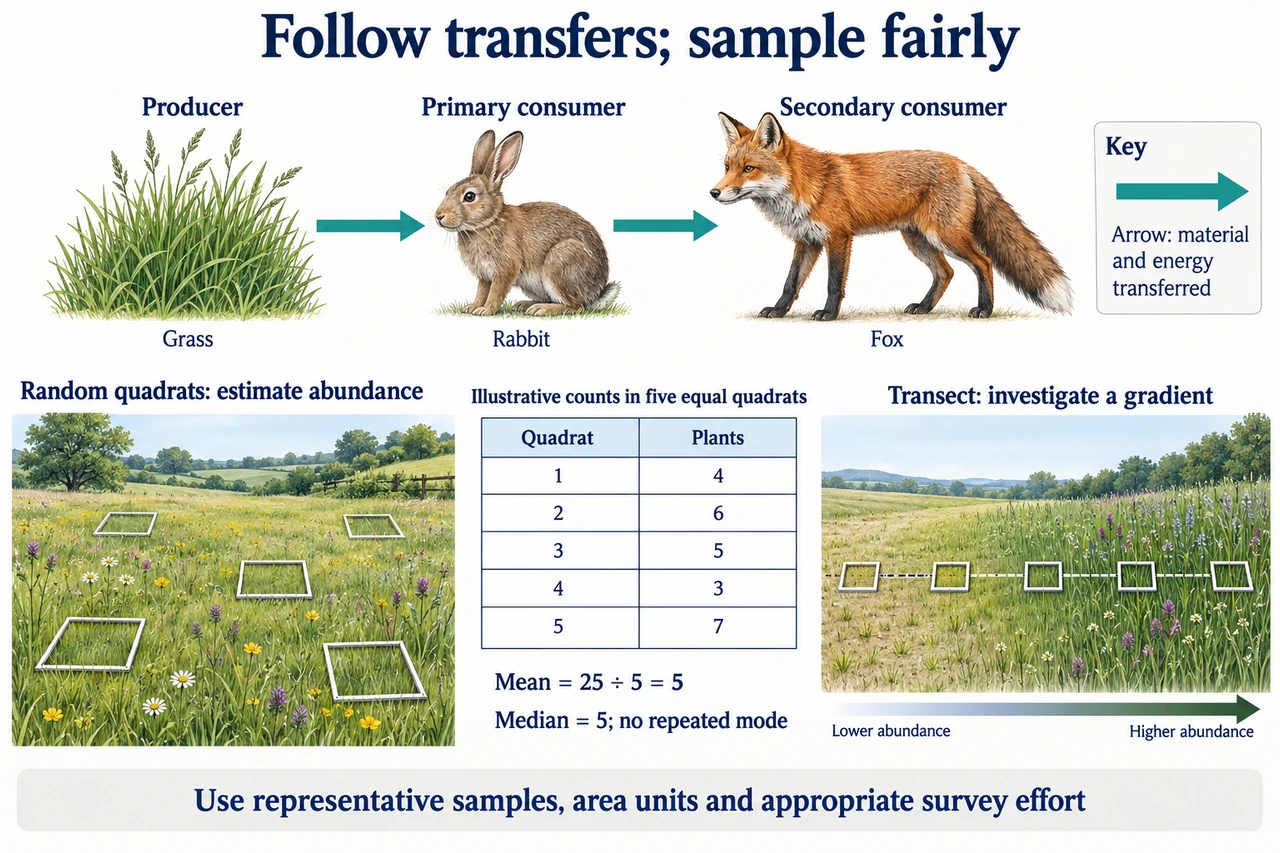
Original myAudience scientific illustration; not a documentary photograph or measured specimen. · Original generated project artwork; no textbook figure copied.
Linking organisms across ecosystems
Feeding relationships connect producers and consumers. Producers incorporate energy into organic material; consumers obtain material by feeding. Food chains simplify one route, while food webs show several connected routes. Arrows commonly point from the food toward the organism receiving its material and energy.
To estimate abundance of plants, random quadrat sampling can reduce selection bias. Estimate a mean count per unit area and apply it only where the samples represent the area. A transect instead helps investigate change along a gradient. The method should answer the question: estimating overall abundance and explaining a distribution are not identical tasks.
Keep abundance calculations tied to the sampled area. Five equal quadrats containing 4, 6, 5, 3 and 7 plants have a mean of five, a median of five and a mode only if a value repeats; here there is no repeated mode. A random sample estimates overall abundance, while a transect samples change along a chosen gradient. Food-chain arrows describe transfer from consumed material to consumer rather than the direction an animal looks.
Worked example: Ten 1 m² quadrats contain a total of 80 plants. Estimate abundance in a representative 100 m² area.
Mean density is 80/ 10=8 plants per m²
Multiply 8 by 100
Answer: The estimate is 800 plants, subject to sampling assumptions.
Check your understanding: What does a food-chain arrow usually show?
Answer: The direction of transfer from food to consumer.
Why: It is not normally an arrow pointing from predator toward prey.