Recycling substances through nature
By UK GCSE Biology · independent study · myAudience
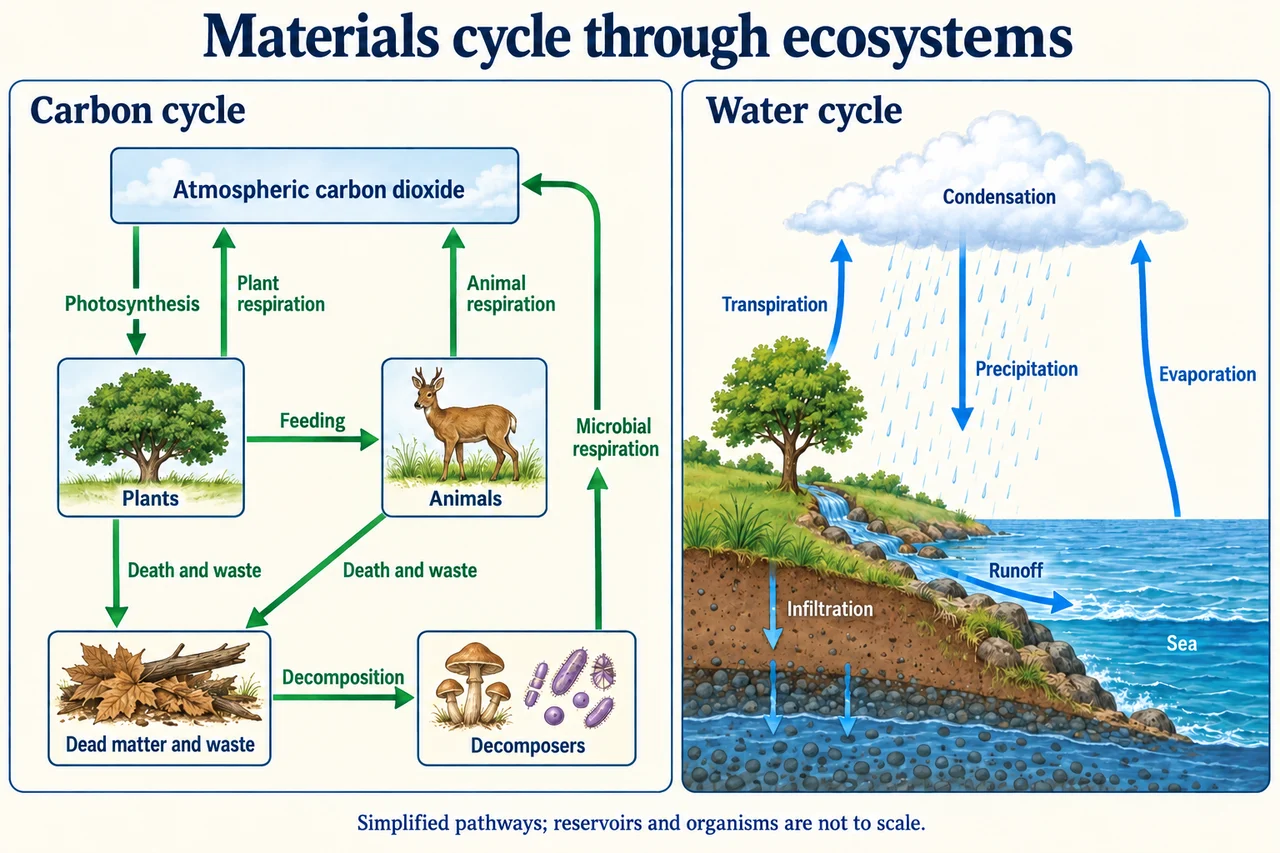
Original AI-generated myAudience scientific concept illustration; not a micrograph or measured specimen. · Original generated project artwork; no source textbook figures reused. Reference links support subject review, not a copied-art license.
Recycling substances through nature
Photosynthesis incorporates carbon dioxide into organic molecules; feeding moves carbon between organisms. Respiration returns carbon dioxide, and microbial decomposition releases mineral ions while microbes respire. Combustion also releases carbon from stored material. A plant can take in carbon dioxide through photosynthesis and release it through respiration, so its role cannot be represented by only one unnamed arrow.
The water cycle links evaporation, condensation, precipitation, runoff and infiltration with stores in land, water and organisms. These processes have distinct mechanisms and timescales. Keep cycling matter separate from energy transfer: atoms can be reused, while energy enters ecosystems and is ultimately dispersed to the surroundings. Mineral ions returned by decay are not themselves recycled energy.
Worked example: Trace one route for carbon from air through a plant back to air.
Photosynthesis incorporates atmospheric carbon dioxide
Carbon enters plant organic molecules
Answer: Plant respiration can return some carbon as carbon dioxide.
Check your understanding: Is energy recycled in exactly the same way as carbon atoms?
Answer: No.
Why: Energy is transferred and dissipated, while atoms can pass repeatedly through material cycles.