Breaking down organic remains
By UK GCSE Biology · independent study · myAudience
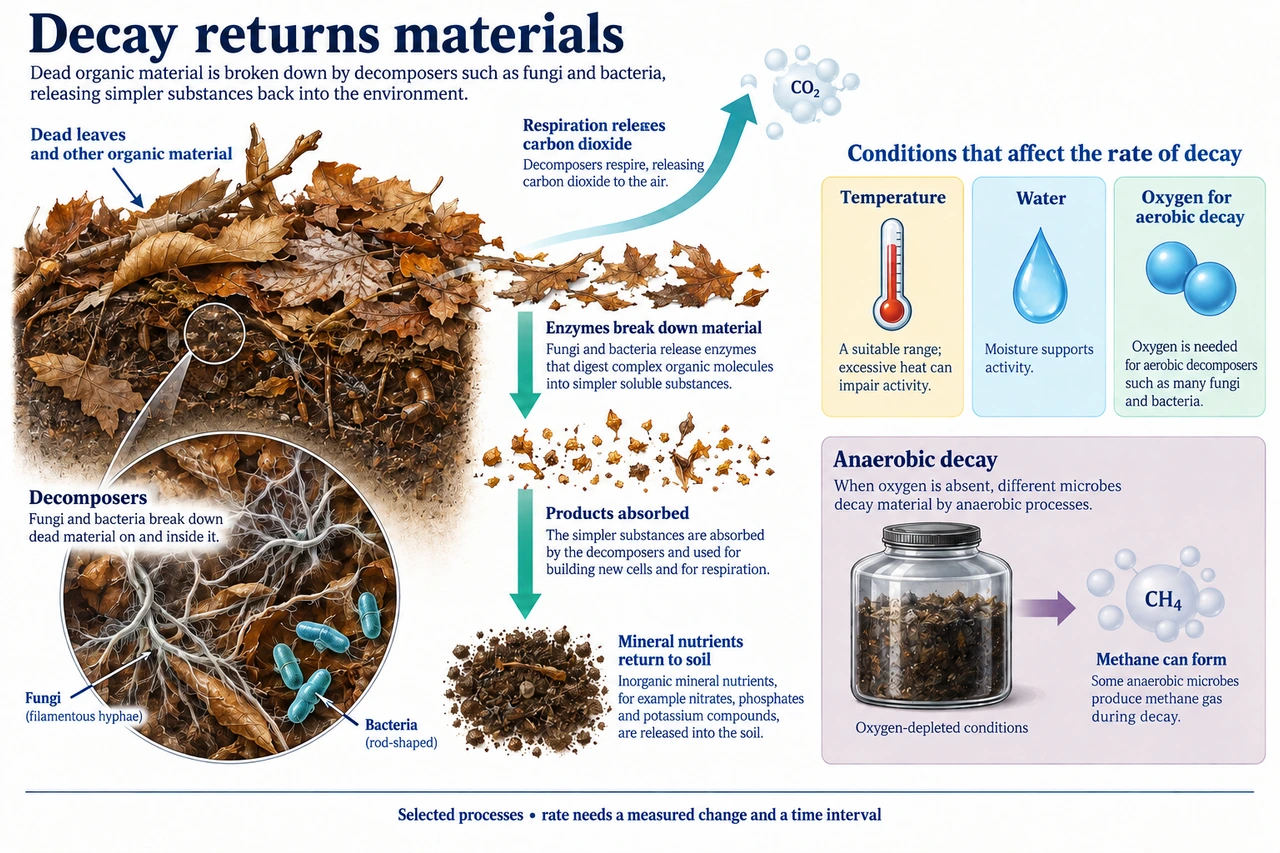
Original myAudience scientific illustration; not a documentary photograph or measured specimen. · Original generated project artwork; no textbook figure copied.
Breaking down organic remains
Decomposers break down dead material and waste, making substances available for further cycling. Many microorganisms use enzymes to digest material and then absorb products. Suitable temperature, moisture and oxygen can affect the rate of aerobic decomposition.
Decay supplies reusable materials rather than making waste disappear. Composting uses decomposer activity, while anaerobic processes can contribute to biogas production under controlled conditions. In a supervised investigation, compare the same substrate and exposure period. A visible color change or lost mass needs an explanation of what was measured, not an assumption that every change is caused by one microbe.
Temperature affects enzyme-mediated activity: warming can accelerate decay within a suitable range, while excessive heat can impair organisms and enzymes. Water supports reactions and transport; oxygen supports aerobic routes, but anaerobic decay can still occur and produce methane in suitable systems. Compost returns useful material to soil. Comparing rates requires a defined outcome and time interval, not assuming a strongly coloured sample has necessarily lost the most mass.
Worked example: Why might very dry conditions slow decomposition?
Microbial activity depends on suitable conditions
Water supports cellular processes and reactions
Answer: Lack of moisture can limit decomposition rate.
Check your understanding: Does all dead material decay at the same rate?
Answer: No.
Why: Material properties, organisms and environmental conditions all influence the process.