Variety of living organisms
By UK GCSE Biology · independent study · myAudience
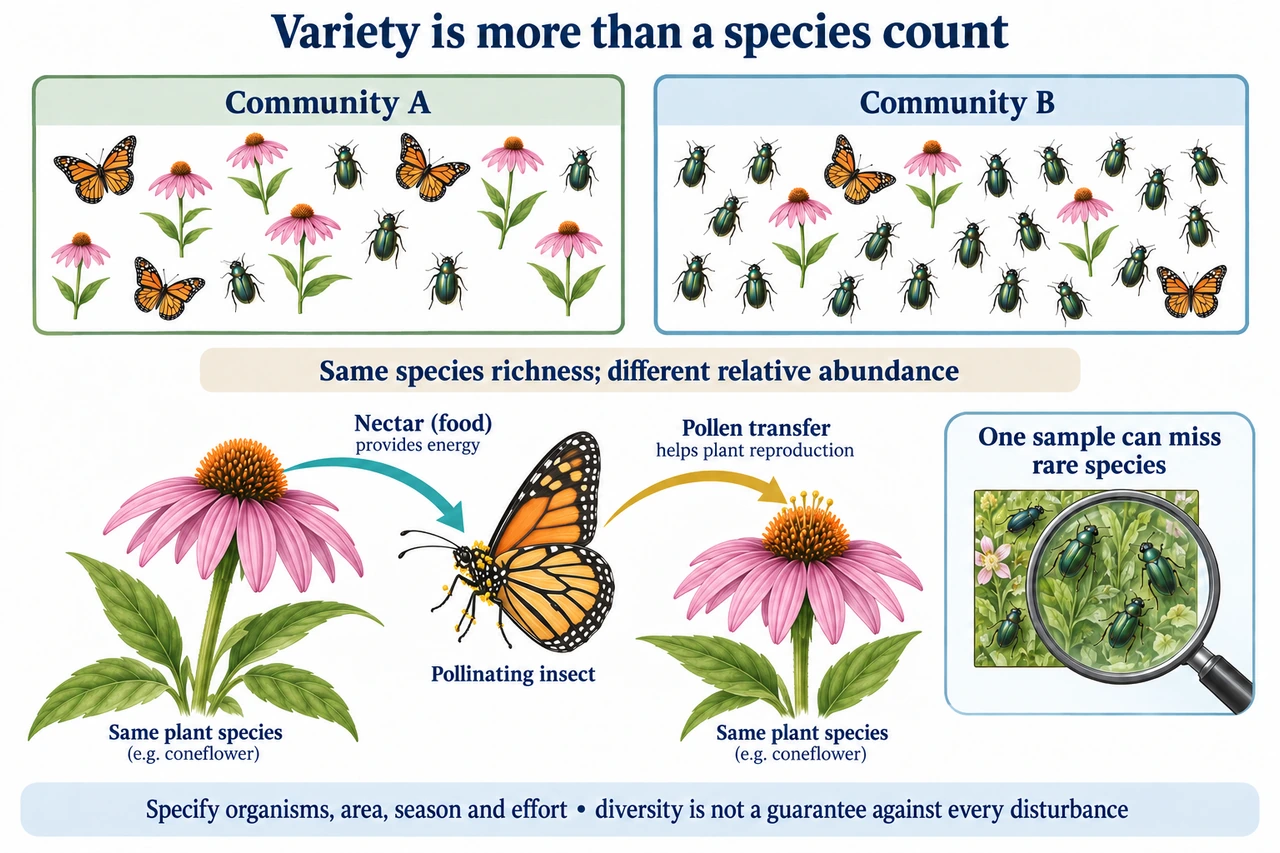
Original myAudience scientific illustration; not a documentary photograph or measured specimen. · Original generated project artwork; no textbook figure copied.
Variety of living organisms
Biodiversity describes variety in living systems, including species diversity. Populations interact through feeding, pollination and other relationships. Loss of one species can therefore affect a wider network, not just remove one name from a list.
Sampling effort changes the chance of detecting species. Two surveys using different areas or seasons may not be directly comparable. Conservation evaluates ecological roles, habitats and threats alongside measured diversity. Explain what the survey counted and what it missed rather than treating a short list of visible organisms as a complete inventory.
Species richness counts species, while evenness concerns their relative abundances; a short survey may capture neither completely. More varied ecological relationships can reduce reliance on one food or shelter source, but biodiversity is not a guarantee against every disturbance. Conservation comparisons should specify the location, scale and organisms sampled. A rare species overlooked by one small sample has not been demonstrated absent from the entire site.
Worked example: Two sites contain the same number of species but very different abundances. Are their communities identical?
Species richness is only one measure
Abundance patterns also differ
Answer: No; equal species counts do not imply identical communities.
Check your understanding: Can loss of a pollinator affect other species?
Answer: Yes.
Why: Interdependence can connect its decline with plant reproduction and other feeding relationships.