Human choices about landscapes
By UK GCSE Biology · independent study · myAudience
Original myAudience scientific illustration; not a documentary photograph or measured specimen. · Original generated project artwork; no textbook figure copied.
Human choices about landscapes
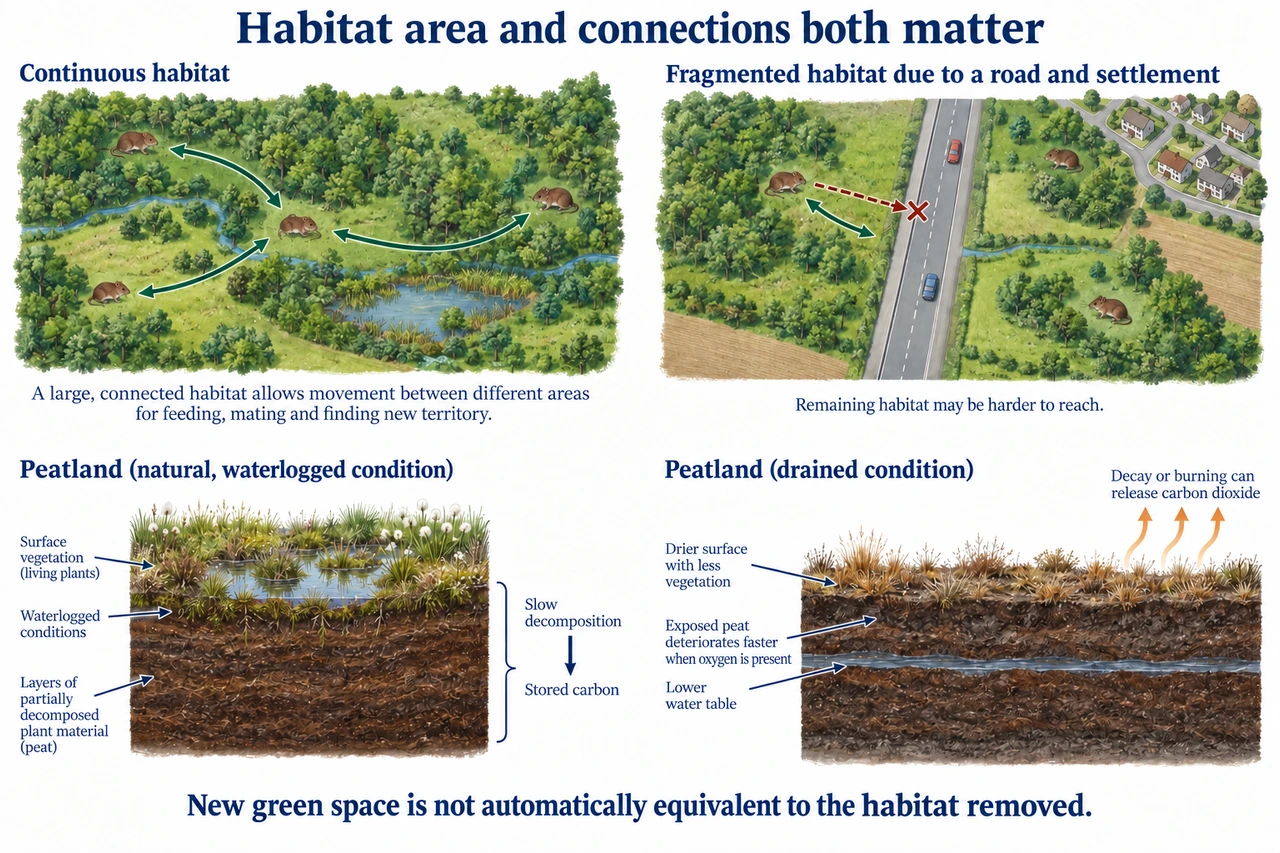
People use land for housing, farming, industry and extracting resources. These uses can change habitats, fragment populations and alter water or nutrient conditions. The biological effect depends on the original habitat, the activity and how it is managed.
A proposed land-use change can meet human needs while creating ecological trade-offs. Compare alternative sites, retained connections and mitigation evidence rather than assuming that one label establishes the outcome. A recreated green area may differ from the habitat it replaces in species, soils and interactions, so area alone does not prove ecological equivalence.
Peatlands store carbon because plant remains accumulate under conditions that slow decomposition. Draining, extracting or burning peat can destroy habitat and release carbon dioxide. A landscaping choice therefore affects more than the appearance of a bag of compost: carbon storage, specialist species and water conditions matter. New green space can be beneficial, but it does not automatically reproduce the soil history or ecological functions of the removed habitat.
Worked example: Why can habitat fragmentation affect a population even if some habitat remains?
Remaining patches may become isolated
Movement, reproduction and access to resources can be restricted
Answer: The usable habitat network can change beyond the area directly removed.
Check your understanding: Is total habitat area the only factor affecting its value?
Answer: No.
Why: Connectivity, quality and the species’ requirements also matter.