Consequences of forest removal
By UK GCSE Biology · independent study · myAudience
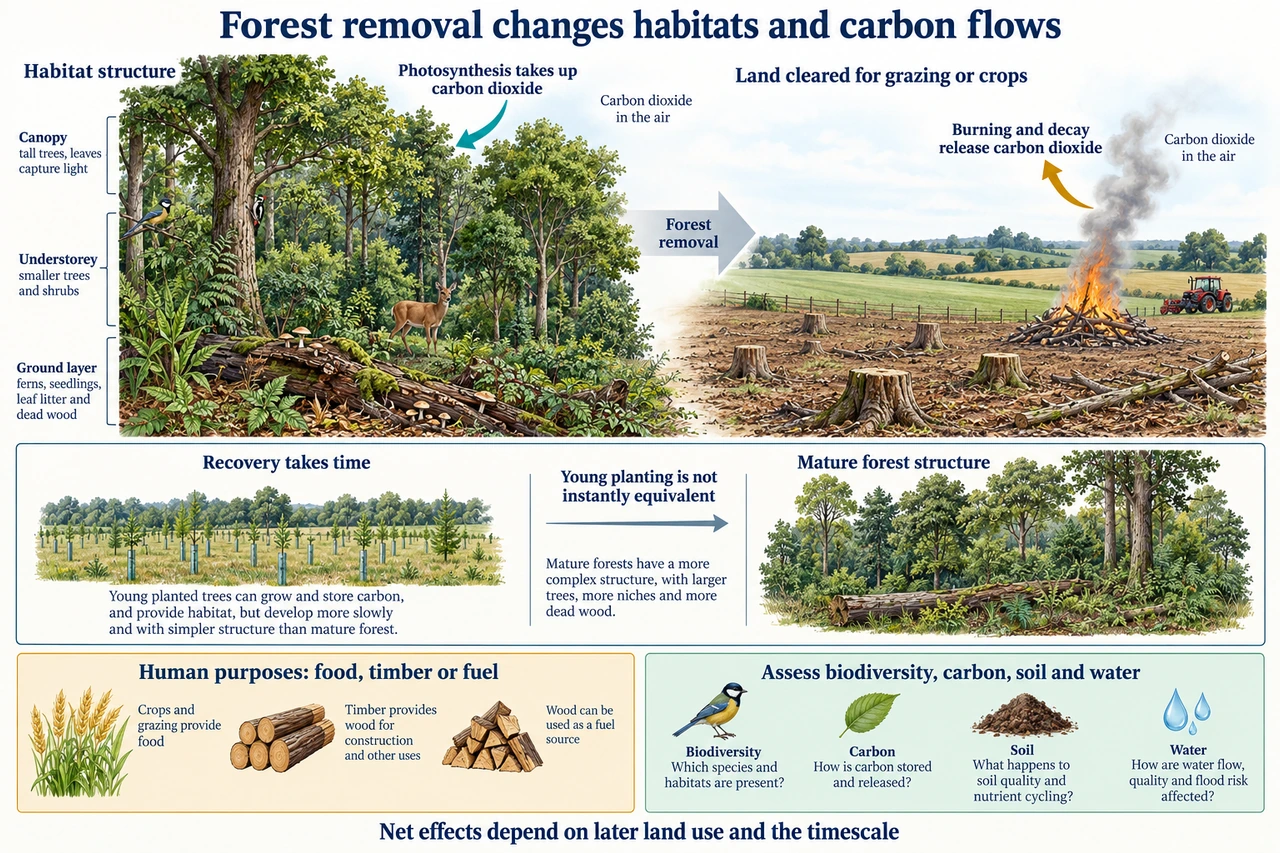
Original myAudience scientific illustration; not a documentary photograph or measured specimen. · Original generated project artwork; no textbook figure copied.
Consequences of forest removal
Deforestation removes trees and can change habitats, reducing opportunities for forest species. Burning biomass releases carbon dioxide, while fewer trees may take up less carbon through photosynthesis. Effects also depend on soil changes, later vegetation and the reason for removal.
Reasons for clearance can include agriculture, grazing and use of timber, each with different benefits and consequences. Compare biodiversity, carbon storage, soil and water effects as well as the human purpose. Replanting can support recovery, but young or differently managed woodland does not instantly reproduce every property of the previous forest.
Clearance for cattle, crops or biofuel production replaces a complex habitat with a different land use. Burning releases carbon, while later decay and soil changes can add emissions; loss of trees also changes future uptake. The net effect depends on what grows afterward and on time. Replanting contributes recovery, but a young plantation is not immediately equivalent to an old forest’s structures, interactions and accumulated carbon.
Worked example: Name two distinct consequences of removing a forest.
Identify habitat structure and carbon flows separately
Removal can reduce habitat and change carbon uptake or release
Answer: Biodiversity and carbon cycling can both be affected through different mechanisms.
Check your understanding: Does planting young trees instantly reproduce an old forest ecosystem?
Answer: No.
Why: Species relationships, structure and stored carbon develop over time.