Rising global temperatures
By UK GCSE Biology · independent study · myAudience
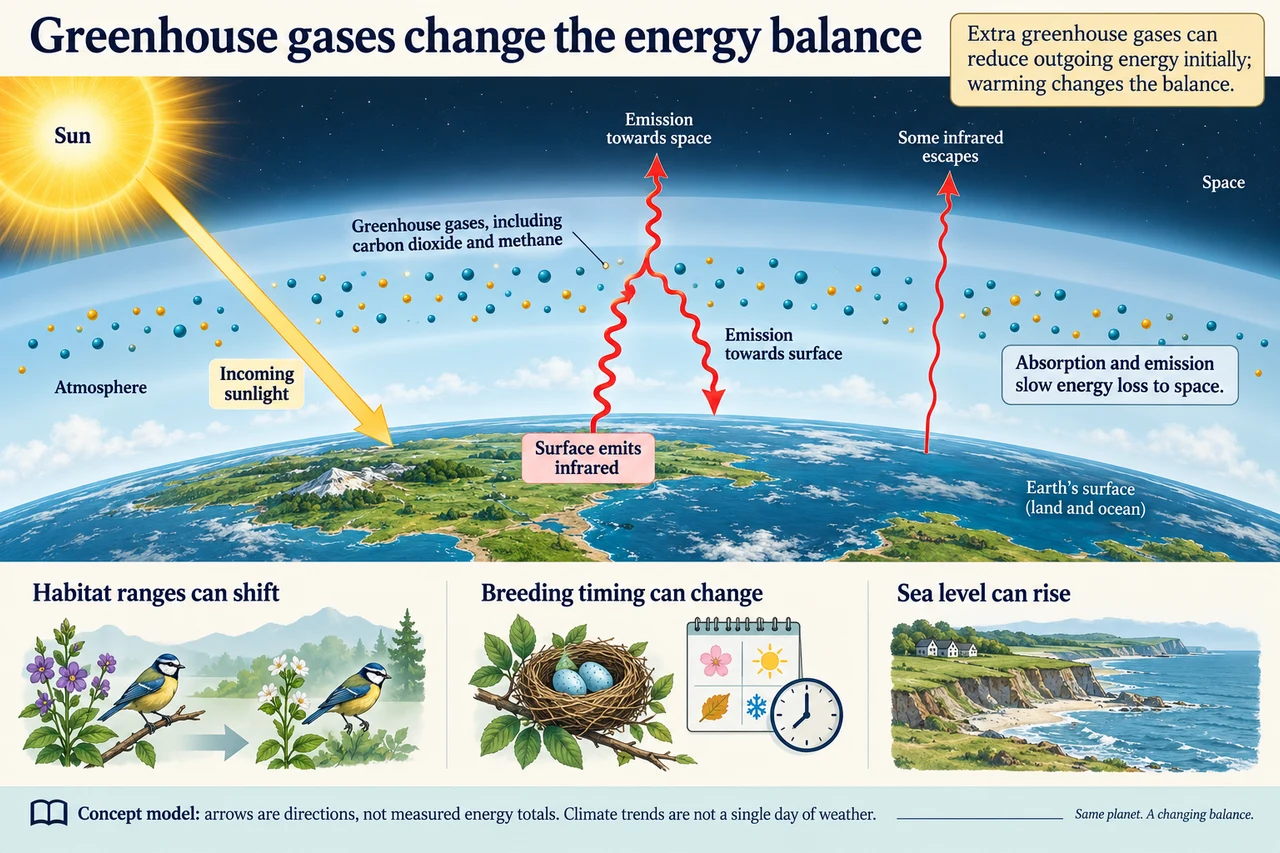
Original myAudience scientific illustration; not a documentary photograph or measured specimen. · Original generated project artwork; source concepts reviewed, no textbook figures copied.
Rising global temperatures
Greenhouse gases absorb and re-emit some infrared radiation, affecting Earth’s energy balance. Increasing their atmospheric concentrations can alter climate. Carbon dioxide released by human activities contributes to the current warming trend; greenhouse warming is different from depletion of stratospheric ozone.
A climate trend is evaluated across long periods and many observations, not disproved by one cold day. Warming can alter habitats, sea levels and weather-related conditions, while local outcomes vary. Explain the measured quantity, timescale and uncertainty rather than turning a complex global process into a prediction from one generated landscape.
Carbon dioxide and methane contribute to greenhouse warming through effects on outgoing infrared radiation. The natural greenhouse effect makes Earth much warmer than it would otherwise be; adding greenhouse gases alters that balance. Long-term warming can change migration, breeding timing, suitable habitats and sea level. Climate evidence combines many observations over time, while the expected biological effect still depends on species, geography and interacting pressures.
Worked example: Why does one cold week not by itself overturn a long-term warming trend?
Weather varies over short periods
Climate trends use longer records
Answer: A short local episode does not establish the global long-term pattern.
Check your understanding: Are the greenhouse effect and the ozone hole the same process?
Answer: No.
Why: They involve different atmospheric mechanisms and should not be used as interchangeable explanations.