Protecting life's variety
By UK GCSE Biology · independent study · myAudience
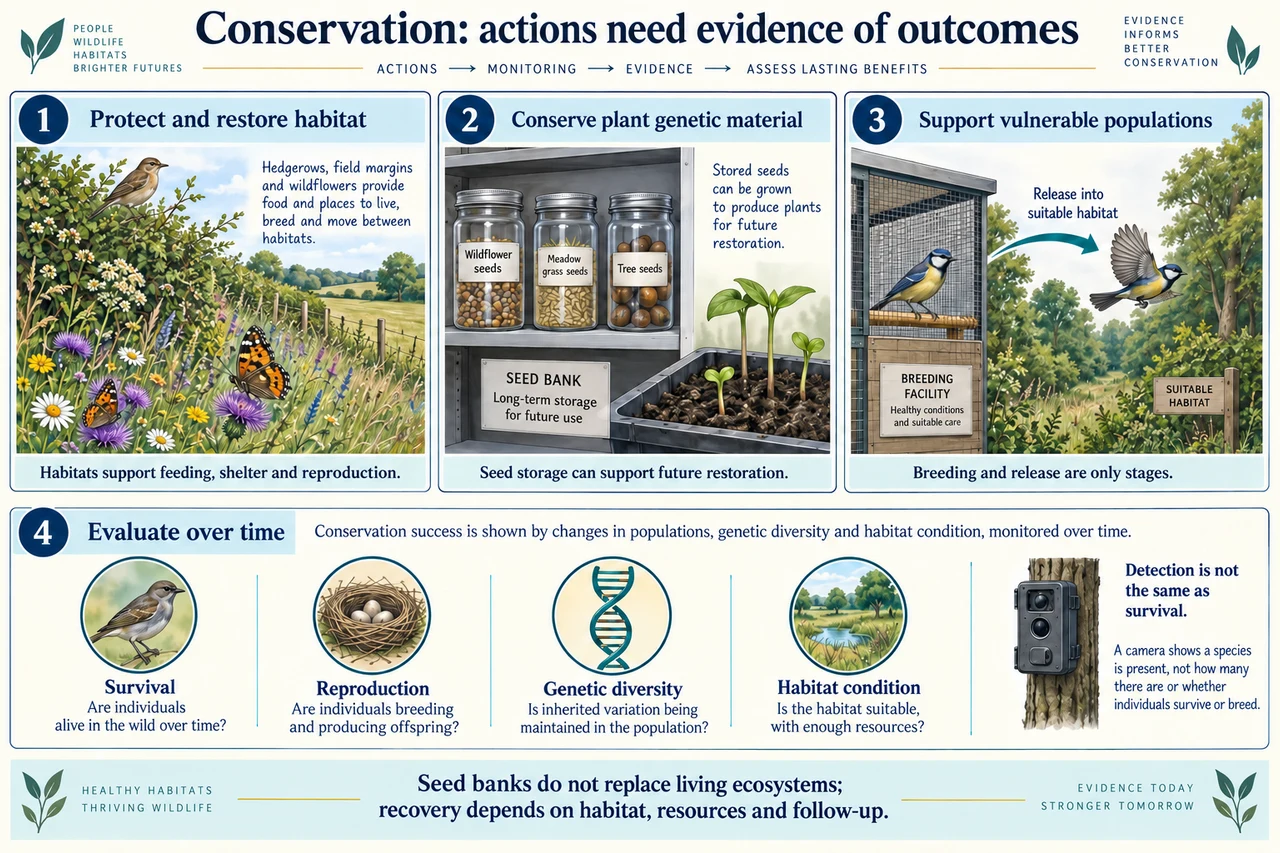
Original myAudience scientific illustration; not a documentary photograph or measured specimen. · Original generated project artwork; source concepts reviewed, no textbook figures copied.
Protecting life's variety
Conservation can protect habitats, reduce damaging pressures and support vulnerable populations. Approaches include habitat restoration, protected areas, breeding programs and changes in land management. Their effectiveness depends on the species, location, sustained resources and evidence of outcomes.
Evaluate success using suitable measures such as survival, reproduction, genetic diversity and habitat condition over time. Human interests and resource constraints also influence decisions. A conservation program should report both benefits and limitations, rather than presenting the number released or the size of a protected area as automatic proof of long-term recovery.
Approaches include protecting and restoring habitat, preserving hedgerows and field margins, reducing destructive practices, and supporting vulnerable breeding populations. Seed banks preserve plant genetic material, but stored seeds do not maintain every relationship in a living habitat. A breeding programme requires appropriate habitat, health, genetic diversity and follow-up after release. Conservation outcomes should be evaluated over time rather than treating a programme’s announcement as evidence of recovery.
Worked example: Why should a breeding-and-release program monitor animals after release?
Release is only one stage
Survival and reproduction determine population effects
Answer: Follow-up is needed to assess whether the program achieves its aim.
Check your understanding: Does a higher release count guarantee conservation success?
Answer: No.
Why: It does not establish later survival, breeding or habitat suitability.