Feeding positions in ecosystems
By UK GCSE Biology · independent study · myAudience
Original myAudience scientific illustration; not a documentary photograph or measured specimen. · Original generated project artwork; source concepts reviewed, no textbook figures copied.
Feeding positions in ecosystems
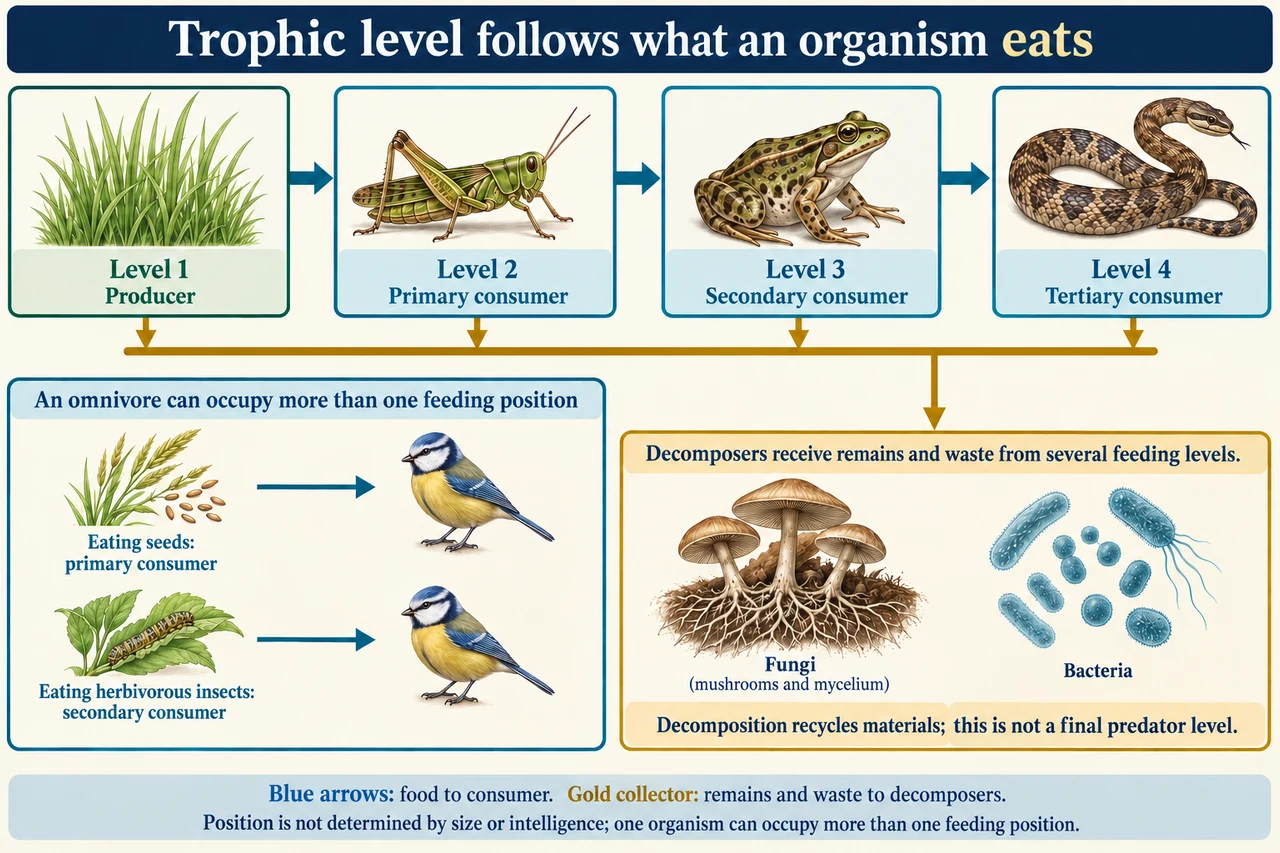
Trophic levels describe positions in a feeding sequence. Producers occupy the starting level, primary consumers eat producers, and further consumers feed on other consumers. A food web can place an omnivore at more than one feeding position depending on its food.
Decomposers obtain material from remains and waste across several levels. A food web helps show this broader network, whereas a short food chain selects one route. Follow the arrows according to their stated convention and identify the material transfer; an arrow toward a plant does not mean the plant is necessarily chasing the animal.
A producer supplies the starting biomass in the familiar photosynthetic food-chain model. Primary, secondary and tertiary consumers describe feeding position, not organism size or intelligence. An omnivorous bird can be primary when eating seeds and secondary when eating a herbivorous insect. Decomposers draw on remains and waste from several positions, so they should not be forced into one final box that only receives material from the top predator.
Worked example: Grass is eaten by a rabbit, which is eaten by a fox. Identify the rabbit’s level.
Grass is the producer
The rabbit feeds directly on the producer
Answer: The rabbit is a primary consumer.
Check your understanding: Must an omnivore occupy only one trophic level?
Answer: No.
Why: Its feeding position depends on which organisms it consumes in the route being considered.