Following biomass between organisms
By UK GCSE Biology · independent study · myAudience
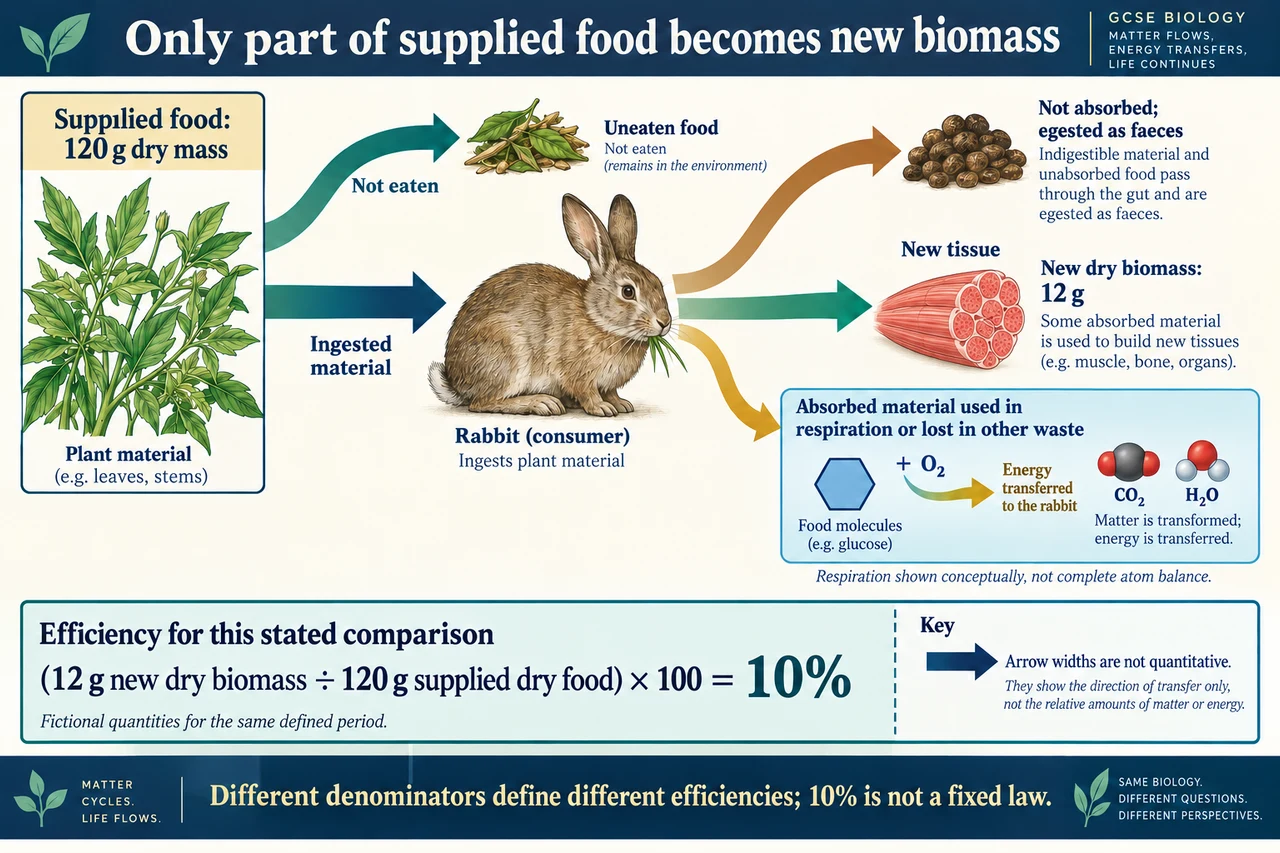
Original myAudience scientific illustration; not a documentary photograph or measured specimen. · Original generated project artwork; source concepts reviewed, no textbook figures copied.
Following biomass between organisms
Only part of the material eaten becomes new consumer biomass. Some is not ingested or absorbed; some is lost in waste. Respiration also transforms organic material into products such as carbon dioxide and water while supporting cellular activity.
Efficiency calculations need matched quantities over a defined period. If 18 g of new dry biomass arises from 150 g supplied, the illustrative efficiency is 18/150 × 100 = 12%. That percentage depends on what supplied biomass includes. It cannot be compared fairly with another value using a different denominator or wet mass instead of dry mass.
Losses between feeding levels include material that is not eaten, indigestible material leaving as faeces, and absorbed material used in respiration rather than becoming new tissue. Respiration transforms organic substances and transfers energy; matter does not vanish. If 12 g of new dry biomass results from 120 g supplied, the stated ratio is 10%. A different denominator, such as absorbed rather than supplied food, would define a different efficiency.
Worked example: A consumer produces 12 g of new dry biomass from 120 g supplied. Calculate transfer efficiency.
Use new biomass÷supplied biomass
Calculate 12/120×100
Answer: Transfer efficiency is 10%.
Check your understanding: Does unconverted food biomass simply cease to exist?
Answer: No.
Why: It may remain uneaten, leave as waste or be transformed through metabolism.