Reliable access to food
By UK GCSE Biology · independent study · myAudience
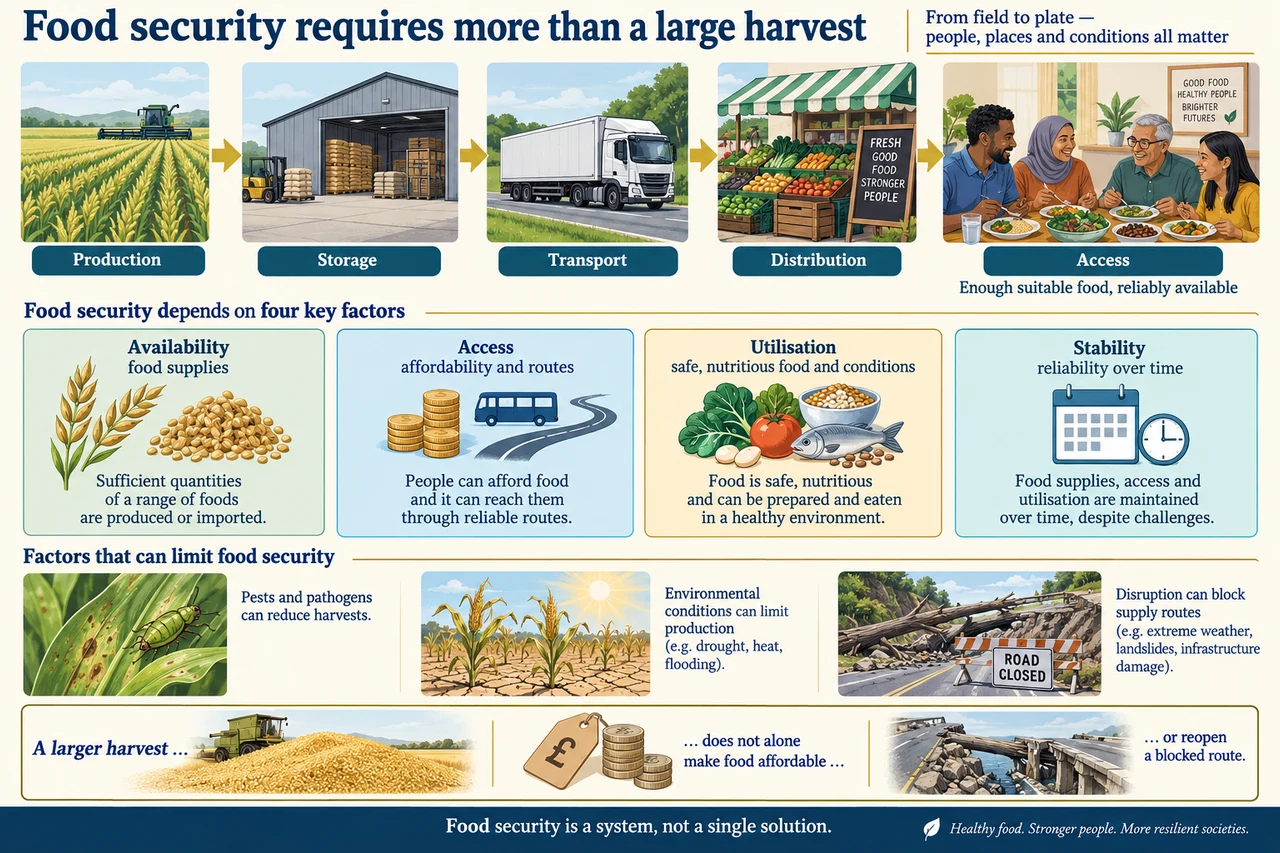
Original myAudience scientific illustration; not a documentary photograph or measured specimen. · Original generated project artwork; source concepts reviewed, no textbook figures copied.
Reliable access to food
Food security is reliable access to sufficient suitable food. Production, storage, transport, distribution and affordability all affect access. Population growth can raise demand; pests, disease and weather can reduce harvests; conflict can disrupt farming or supply routes. A large national crop does not demonstrate that every household can obtain adequate nutrition.
A response must address the constraint actually limiting access. Resistant crops can reduce a biological loss but cannot alone reopen a blocked transport route. Better distribution cannot replace production destroyed by disease. Specify the region, period and outcome when evaluating a proposal, so improvements in one part of the system are not mistaken for a solution to every food-security problem.
Worked example: A region produces enough food in total but some households cannot obtain it. What additional factors matter?
Production is not the same as access
Distribution and affordability can limit access
Answer: Food security requires considering those constraints as well as yield.
Check your understanding: Can disease in a crop affect food supply?
Answer: Yes.
Why: Reduced survival or growth can lower production and disrupt the supply system.