Methods of agricultural production
By UK GCSE Biology · independent study · myAudience
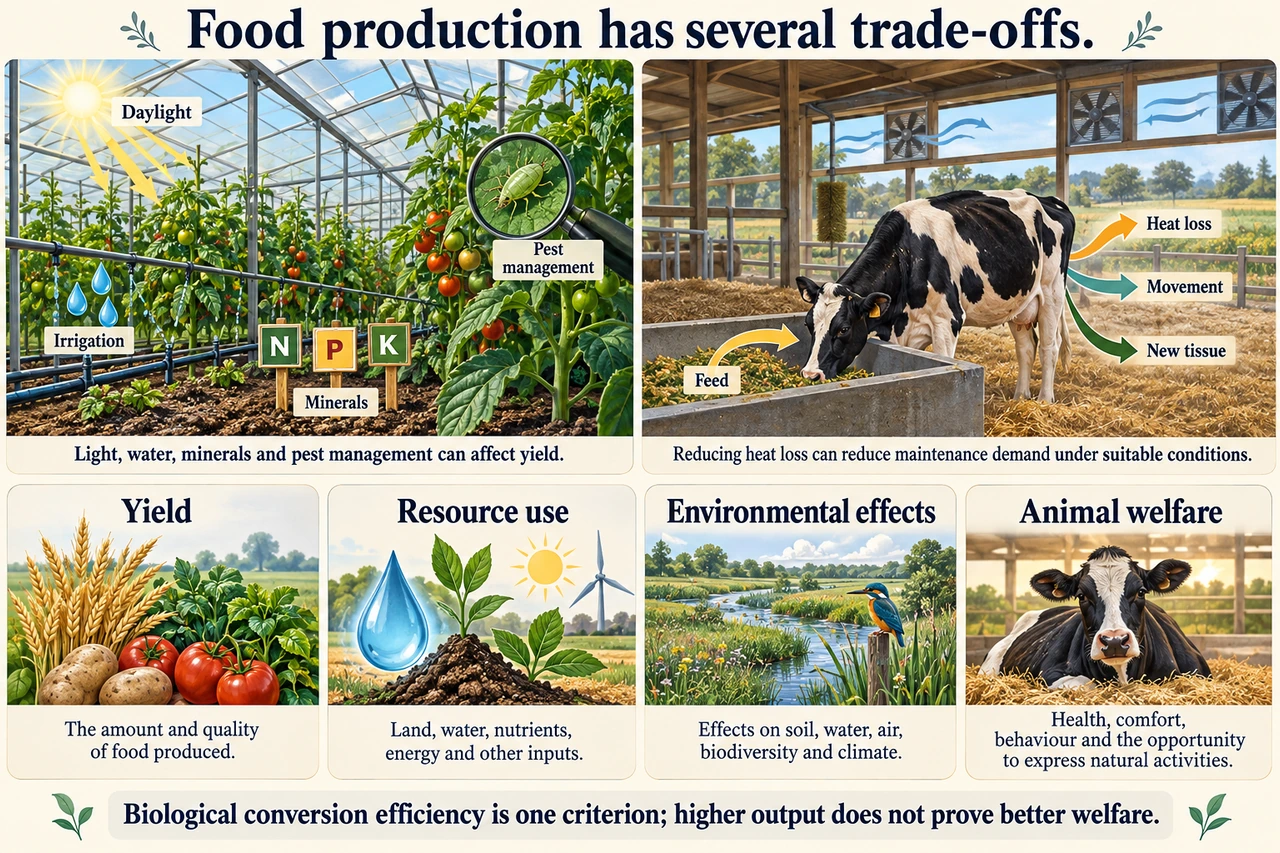
Original myAudience scientific illustration; not a documentary photograph or measured specimen. · Original generated project artwork; no textbook figure copied.
Methods of agricultural production
Agricultural methods can increase the fraction of resources converted into useful food. Managing pests, temperature, nutrients and water can affect production. Animal production may change feed, movement or environmental conditions, but biological gains must be considered alongside welfare and resource use.
Compare yield with resource use, disease risk, waste and welfare using clearly defined measures. A high-output system can depend on substantial inputs, while a lower-output system can have other costs. Biological efficiency is one criterion among several; state which outcome improved and which trade-offs remain instead of ranking all farming methods by one number.
Keeping animals warm can reduce energy demand for maintaining temperature, while restricting activity changes resource allocation. These mechanisms help explain production efficiency but create welfare questions that must be assessed separately. For crops, water, mineral supply, light and pest management can influence yield. Comparing systems requires matching units and considering inputs, emissions, disease risk and humane conditions; biological conversion efficiency alone is not a complete ranking of farming methods.
Worked example: Why might reducing heat loss affect the feed needed by a farm animal?
Maintaining temperature requires energy transfer
Less heat loss can reduce that maintenance demand
Answer: More supplied resources may be available for other functions, under suitable conditions.
Check your understanding: Does higher output automatically prove better animal welfare?
Answer: No.
Why: Production and welfare are different outcomes and need separate evidence.