Managing catches for the future
By UK GCSE Biology · independent study · myAudience
Original myAudience scientific illustration; not a documentary photograph or measured specimen. · Original generated project artwork; no textbook figure copied.
Managing catches for the future
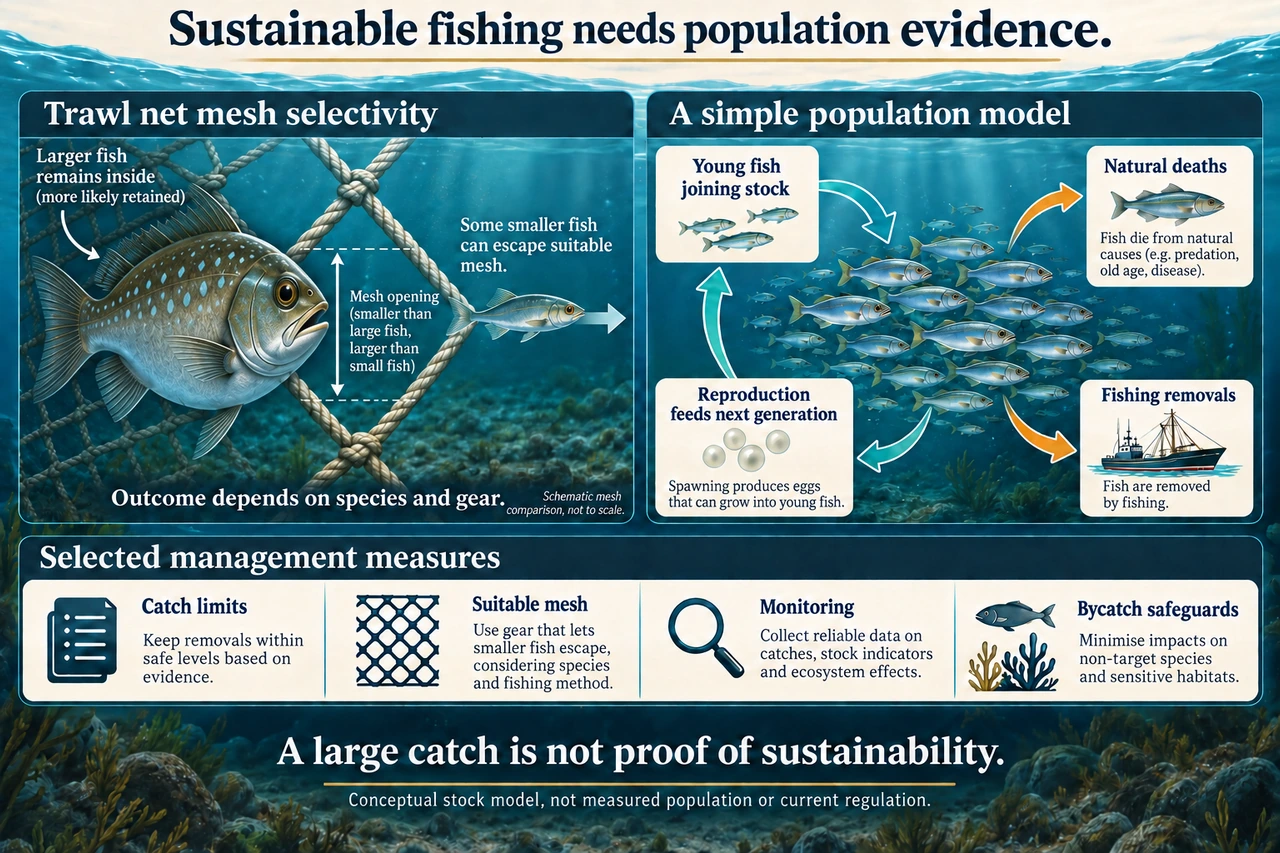
Fish populations depend on successful reproduction and survival as well as the number caught. Catch limits and suitable net mesh sizes can reduce pressure on vulnerable populations, allowing more young fish to grow and reproduce. The effect depends on the species and management context.
Monitoring helps compare removals with the population’s capacity to replace them. A large catch can reflect effort or stock conditions and is not proof of sustainability. Consider breeding populations, bycatch and changing environments. A management claim needs a stated stock, period and evidence rather than a scenic image of many fish.
Catch restrictions and mesh-size rules can reduce removal of certain fish, allowing more to survive to reproductive age. The population also depends on recruitment, natural mortality, habitat and other removals. Monitoring should therefore compare age or size structure and abundance over time, not only weight landed. A rule effective for one stock may need revision as conditions change; sustainability requires evidence that removals can be maintained without exhausting the population.
Worked example: How might a larger mesh reduce removal of small fish?
Mesh openings affect which sizes are retained
Some smaller fish can escape
Answer: More may survive to contribute to future reproduction.
Check your understanding: Does a high current catch establish long-term sustainability?
Answer: No.
Why: It does not by itself show that recruitment and survival can replace the removals.