Connecting core biological principles
By UK GCSE Biology · independent study · myAudience
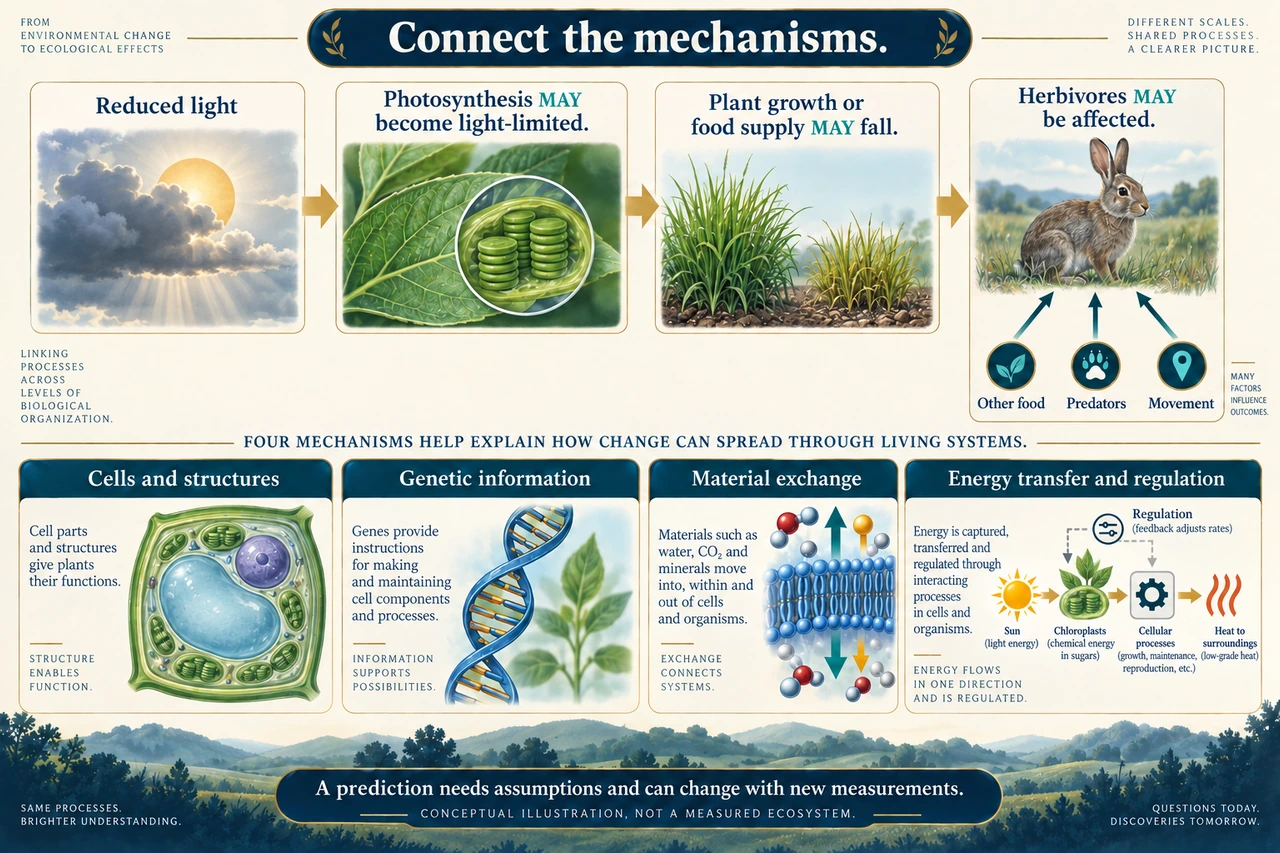
Original myAudience scientific illustration; not a documentary photograph or measured specimen. · Original generated project artwork; no textbook figure copied.
Connecting core biological principles
Biological explanations connect cells, inherited information, energy transfer and interactions with the environment. Structure supports function, but structures develop through gene activity and environmental influences. Organisms exchange materials, regulate internal conditions and reproduce within larger ecological systems.
For a new question, identify the relevant structure, material flow, energy transfer and regulation. Then distinguish a measured observation from a prediction and name conditions that could modify it. For example, reduced photosynthesis can reduce plant growth, but herbivore numbers also depend on other food, predation and movement; a sound answer explains both the link and its limits.
Connect an unfamiliar problem through a chain of mechanisms: identify cells and structures, trace material movement, explain energy transfer and describe regulation. Genetic information influences proteins and development, while environments affect outcomes; ecological interactions add further conditions. A sound prediction states assumptions and could change when new measurements arrive. A memorised keyword such as adaptation is not enough unless the feature, process and reproductive or survival consequence are linked.
Worked example: Link reduced light with a possible change in a herbivore population.
Reduced light can limit plant photosynthesis
Plant growth or food availability may then fall
Answer: Herbivores could be affected, depending on other resources and ecological interactions.
Check your understanding: Does one biological factor determine every ecosystem outcome?
Answer: No.
Why: Several processes and interactions can modify the result of an initial change.