Interpreting bacterial inhibition zones
By UK GCSE Biology · independent study · myAudience
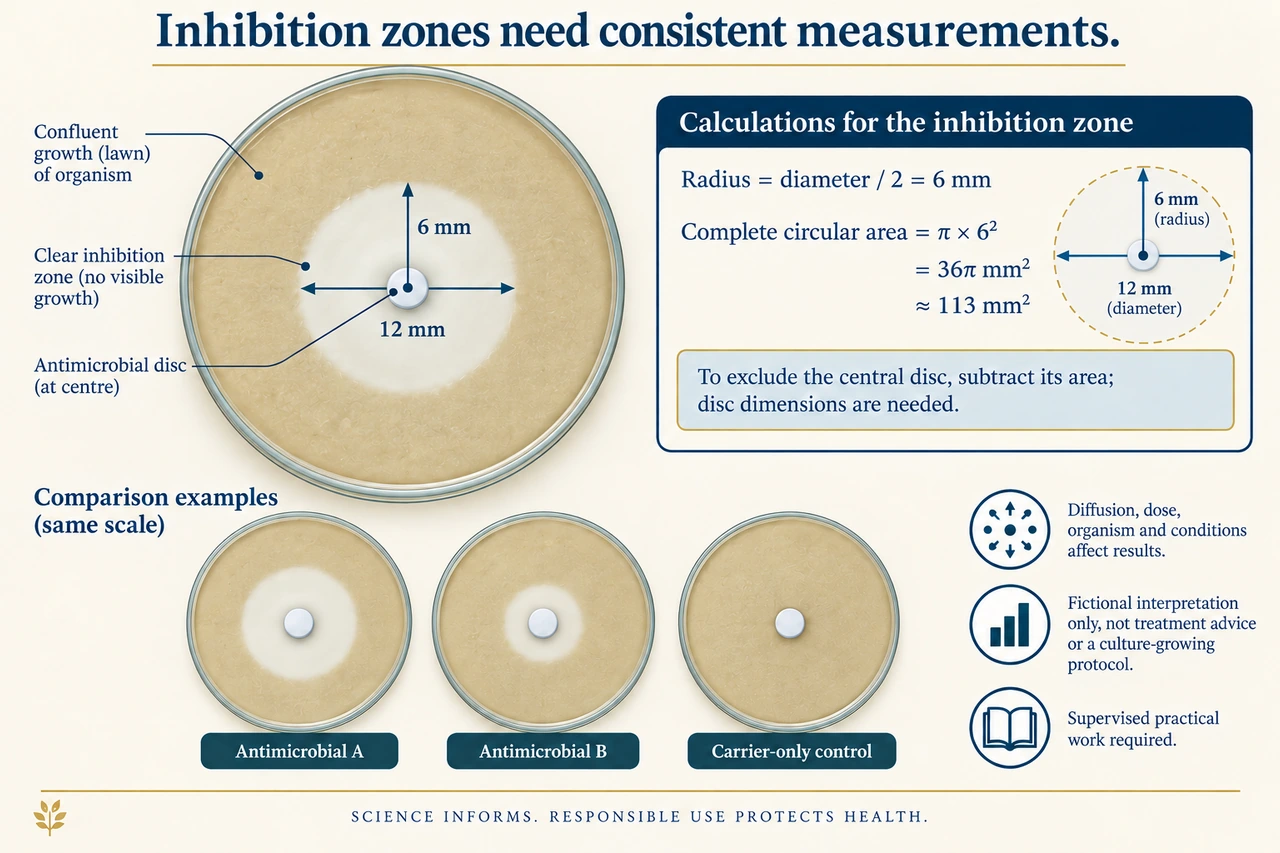
Original myAudience scientific illustration; not a documentary photograph or measured specimen. · Original generated project artwork; no textbook figure copied.
Interpreting bacterial inhibition zones
A clear region around an antimicrobial source on an agar plate can indicate inhibited visible bacterial growth under the conditions tested. This practical study compares these zones, but a larger zone is not a universal clinical ranking: diffusion, dose, organism and exposure conditions also affect the result. This lesson uses fictional data for interpretation and does not provide a culture-growing protocol.
Use the measurement convention stated in the question. For the area of a complete circular clear zone, A = πr² and the radius is half the measured diameter. If only the clear area outside a central disc is requested, subtract the disc’s area. Measure consistently, use repeats and compare like conditions; an irregular zone increases uncertainty in a circle-based approximation.
A control without the active antimicrobial can help identify effects of the carrier or method. Keep bacterial strain, medium, disc dimensions and measurement time comparable when evaluating supplied data. Handling and disposal of cultures require approved school supervision, containment and risk assessment. A classroom inhibition result cannot determine what medicine an individual should use.
Worked example: A circular zone has diameter 12 mm. Estimate its complete area.
Radius is 12 / 2 = 6 mm.
Area is π × 6² = 36π mm².
Answer: The complete circle is about 113 mm²; excluding a central disc would require its dimensions.
Check your understanding: Can the diameter be substituted directly for r in πr²?
Answer: No; first halve the diameter.
Why: Using diameter as radius makes the calculated area four times too large.