Using controls to interpret food tests
By UK GCSE Biology · independent study · myAudience
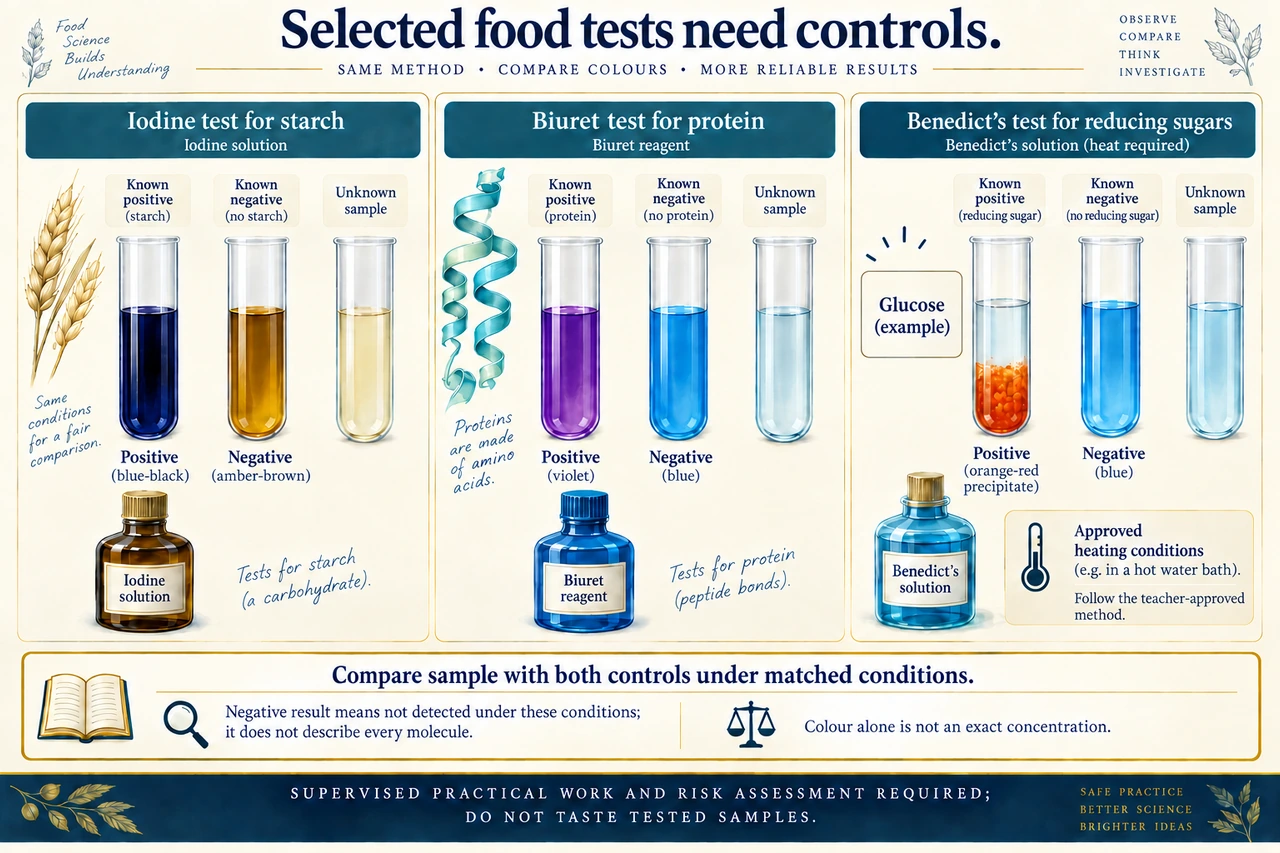
Original myAudience scientific illustration; not a documentary photograph or measured specimen. · Original generated project artwork; no textbook figure copied.
Using controls to interpret food tests
Qualitative food tests identify a response consistent with a class of substances, rather than measuring a complete nutritional profile. In the school models, iodine indicates starch, Benedict’s reagent indicates reducing sugars under the approved test conditions, and Biuret reagent indicates proteins. Lipid tests may use a visible emulsion or a suitable stain. This practical study concerns these identification skills; all reagents and heating require supervised risk assessment.
A positive control contains the substance expected to give the response; a negative control checks whether reagents or the background produce a similar appearance without it. Compare sample and controls under matched conditions. Colour alone can be misleading if a sample is already strongly coloured, and a negative result can reflect a concentration below the test’s detection capability.
Record the initial and final appearance using the stated method. Iodine changing to blue-black supports starch; a violet Biuret response supports protein. Benedict’s positive precipitate can vary in colour, so a simple visual test is not an exact concentration measurement without appropriate calibration. An emulsion is not a protein result. This explanation is not a chemical-handling recipe or permission to taste tested samples.
Worked example: An unknown gives a violet Biuret response but does not turn blue-black with iodine. Interpret these results.
The Biuret response is consistent with protein.
The starch indicator was negative under the conditions used.
Check that positive and negative controls behaved as expected.
Answer: Protein is supported; starch was not detected by this test. These results do not describe every molecule in the sample.
Check your understanding: Does a negative starch test prove the sample contains no carbohydrate?
Answer: No.
Why: Other carbohydrates are not identified as starch by that test, and detection limits also matter.