Comparing amylase activity across pH
By UK GCSE Biology · independent study · myAudience
Original myAudience scientific illustration; not a documentary photograph or measured specimen. · Original generated project artwork; source concepts checked, no textbook figures copied.
Comparing amylase activity across pH
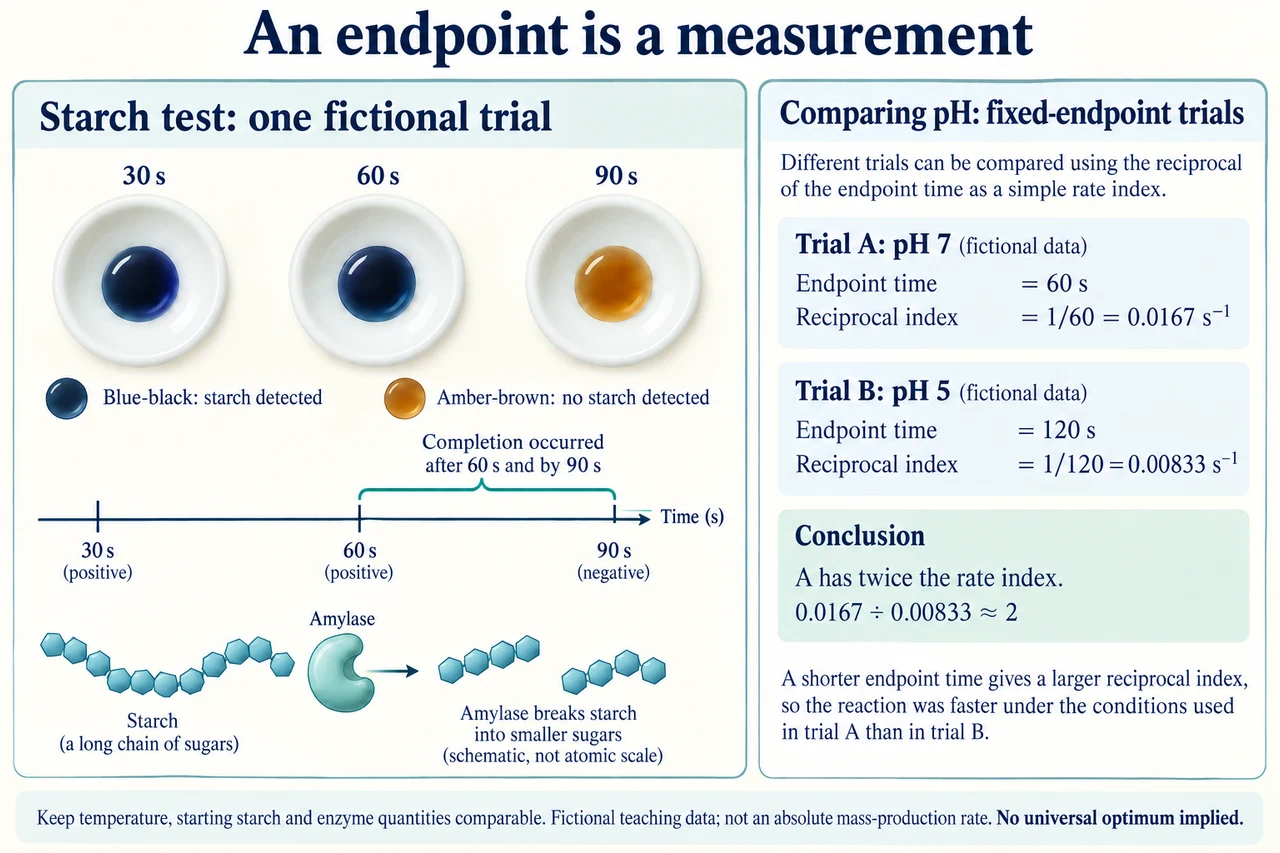
Amylase breaks down starch into smaller sugars. This practical study varies pH and uses repeated samples to identify when starch is no longer detected by iodine. The endpoint is the first tested sample with no positive starch response, not direct measurement of every product molecule. Temperature, starting substrate amount, enzyme amount and sampling interval should be comparable.
For a fixed starting quantity and common endpoint, 1 / time is a useful comparative rate index. A shorter completion time gives a larger index, with units such as s⁻¹. It is not an absolute mass-production rate unless the amount transformed is measured. If sampling is every 30 seconds, an observed endpoint at 90 seconds implies that completion occurred after the previous check and by that check; the interval limits timing precision.
pH can affect enzyme shape and interactions, so different pH values can produce different activity. Repeated endpoints reveal scatter; averaging does not remove an error shared by every measurement. A suitable graph has pH on the horizontal axis and the defined rate index on the vertical axis. The activity pattern concerns the particular enzyme and conditions, not a rule that every enzyme has the same optimum pH.
Worked example: Equal-starting-quantity trials finish at 60 s and 120 s. Compare reciprocal-time indices.
First index: 1 / 60 ≈ 0.0167 s⁻¹.
Second index: 1 / 120 ≈ 0.00833 s⁻¹.
Answer: The first index is twice the second under the fixed-endpoint assumptions.
Check your understanding: Does sampling every 30 seconds give an exact completion time to the nearest second?
Answer: No.
Why: Completion can occur between checks, so the sampling interval limits resolution.