Measuring photosynthetic rate under changing light
By UK GCSE Biology · independent study · myAudience
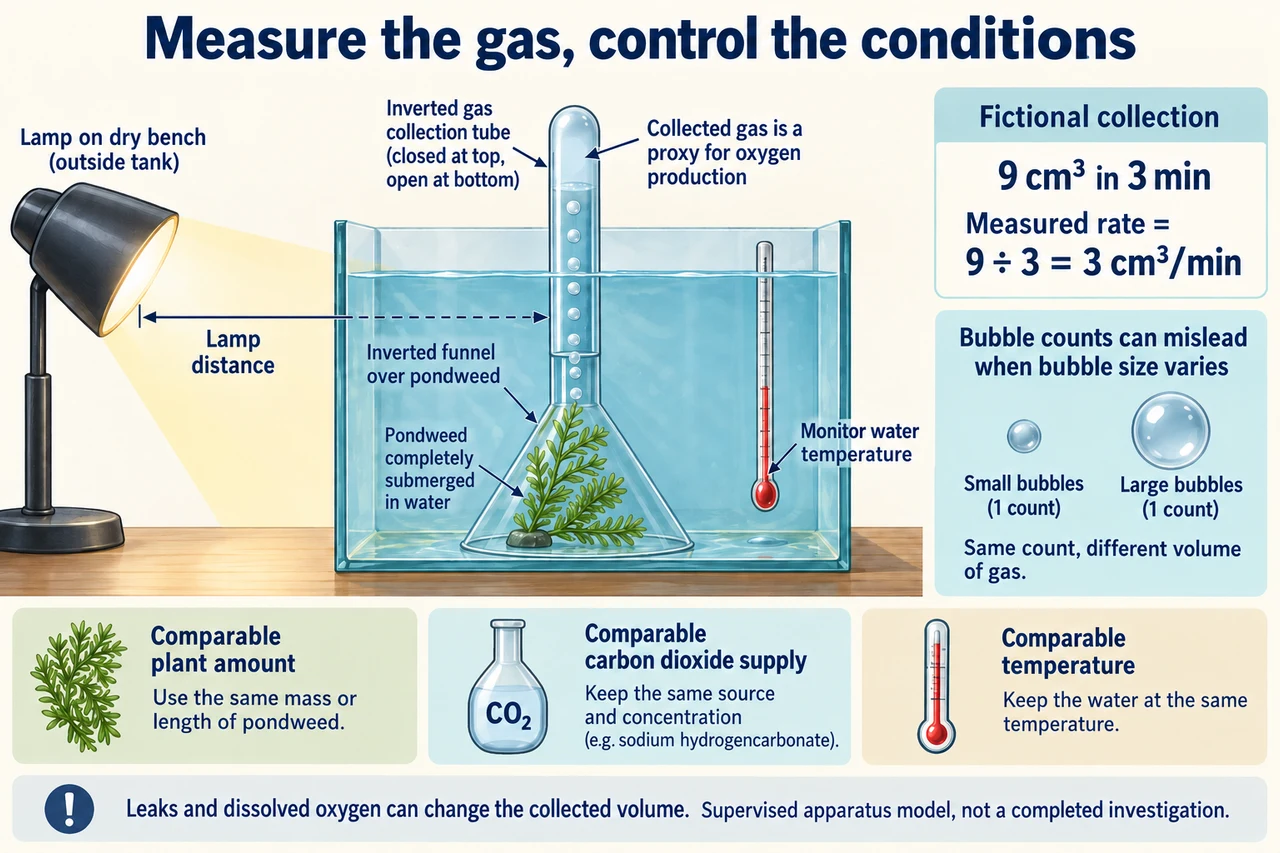
Original myAudience scientific illustration; not a documentary photograph or measured specimen. · Original generated project artwork; source concepts checked, no textbook figures copied.
Measuring photosynthetic rate under changing light
This practical study studies how light intensity affects photosynthesis in an aquatic organism. Oxygen-gas production provides a measurable proxy under stated conditions. Changing lamp distance can change illumination, but temperature, carbon dioxide supply and plant amount must be comparable. A lamp may warm the water as well as brighten it, so distance alone does not guarantee an isolated light effect.
Gas volume divided by elapsed time gives a defined measured rate. Bubble counts are less secure when bubble size varies, and gas collection can miss dissolved oxygen or leaks. Repeats and consistent measurement windows help assess scatter. Plot the manipulated variable with units, then identify whether a rate increase or plateau is supported by the observations rather than drawing a curve simply because it is expected.
Higher-tier extension: under a point-source inverse-square model, intensity is proportional to 1/d². Doubling distance therefore gives one-quarter intensity, not one-half. This model assumes appropriate geometry and does not remove background light or reflections. A rate plateau may reflect another limiting factor. Electrical equipment, water and biological specimens require the teacher’s approved safe setup.
Worked example: A gas collection gives 9 cm³ over three minutes. Calculate the measured rate.
Rate = collected volume / elapsed time.
9 cm³ / 3 min = 3 cm³/min.
Answer: The measured collection rate is 3 cm³/min under the stated conditions.
Check your understanding: Why control temperature while changing lamp distance?
Answer: Temperature can independently affect the rate.
Why: Otherwise a change attributed to light could partly reflect warming.