Evaluating a human reaction-time comparison
By UK GCSE Biology · independent study · myAudience
Original myAudience scientific illustration; not a documentary photograph or measured specimen. · Original generated project artwork; source concepts checked, no textbook figures copied.
Evaluating a human reaction-time comparison
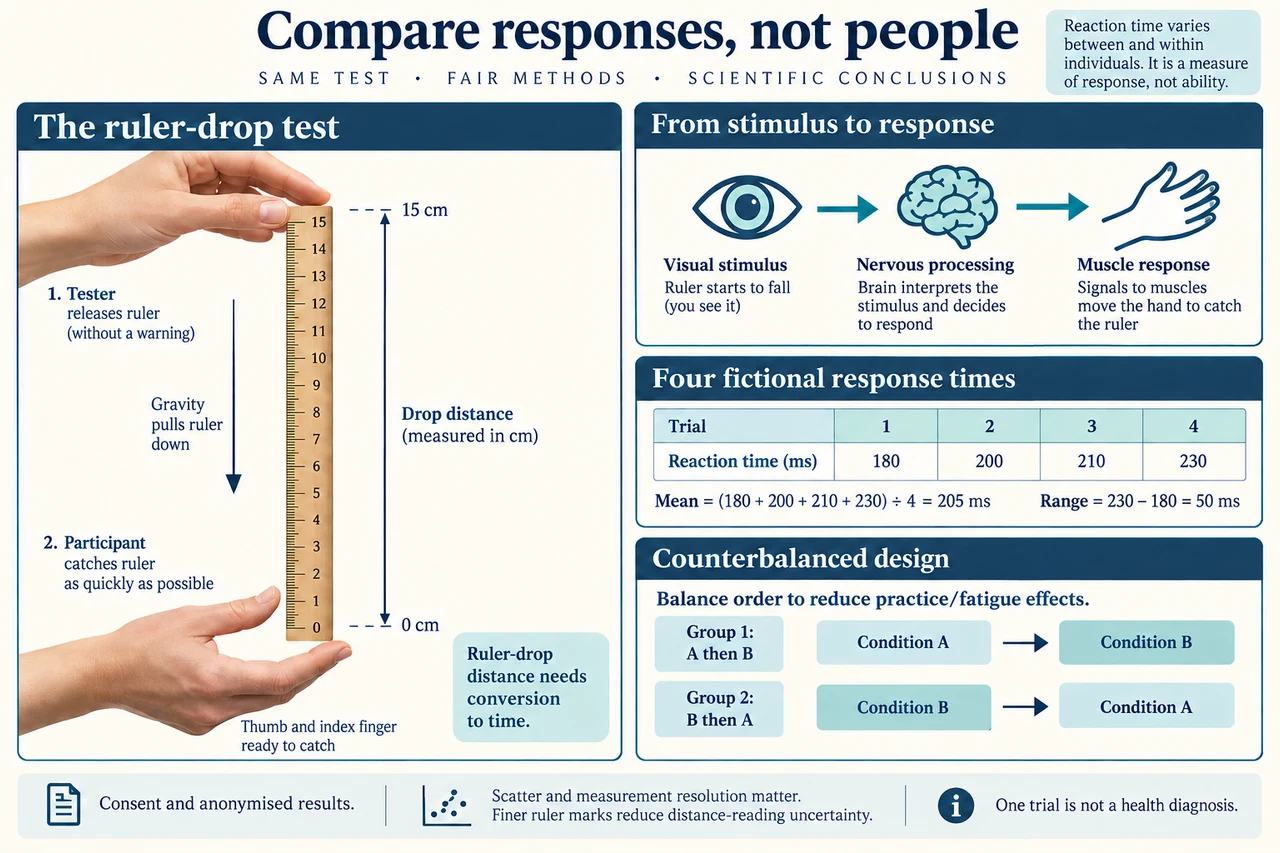
This practical study asks how a factor affects human reaction time. A visual stimulus, nervous processing and muscle response all contribute to a measured response. A ruler-drop distance is a proxy that needs a stated conversion to time; centimetres are not milliseconds. Plan fair comparisons and informed participation, avoiding unsafe substances or any activity that excludes a participant from a comfortable alternative.
Repeats can reveal anticipation, distraction and ordinary variation. Order effects matter: people may improve through practice or slow through fatigue. A paired comparison uses each participant in both conditions and can reduce differences between people, while order should be balanced where appropriate. Keep the stimulus and measurement method comparable, and never interpret one trial as a diagnosis of nervous-system health.
Mean reaction time is total time divided by the number of observations. Medians can reduce the influence of one extreme observation, but an outlier should not be silently removed. A small difference between means needs comparison with scatter and measurement resolution. Personal data require consent and privacy; published class results can be anonymised rather than assigning a public ranking to identifiable students.
Worked example: Four fictional responses are 180, 200, 210 and 230 ms. Find their mean.
Add the times: 820 ms.
Divide by four observations.
Answer: The mean is 205 ms; the range is 50 ms, which helps describe variation.
Check your understanding: Why can always testing condition B second bias the comparison?
Answer: Practice or fatigue can change later responses.
Why: The order can affect results independently of the factor being investigated.