Following seedling growth responses over time
By UK GCSE Biology · independent study · myAudience
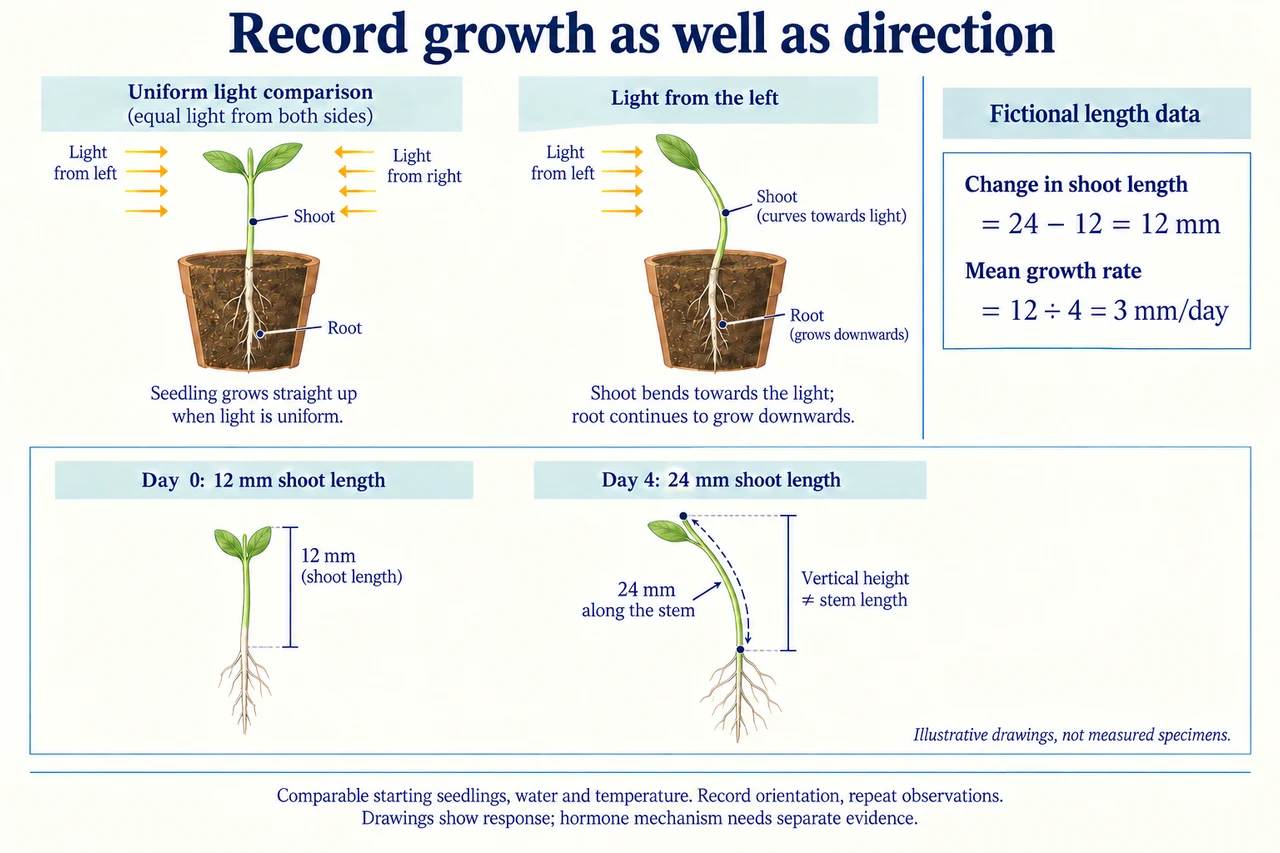
Original myAudience scientific illustration; not a documentary photograph or measured specimen. · Original generated project artwork; source concepts checked, no textbook figures copied.
Following seedling growth responses over time
This practical study compares how directional light or gravity affects seedling growth. Measure and record development over time rather than treating one final bend as the entire investigation. A shoot’s bend can reflect unequal elongation; a root and shoot can respond differently to the same signal. This lesson prepares observation and analysis for supervised plant work, without recording that hands-on requirements have been completed.
A fair comparison uses seedlings of comparable species and starting development, while controlling water, temperature and other conditions. Include a comparison receiving a uniform or different directional stimulus as appropriate to the question. Record orientation and starting position so a drawing can distinguish growth from initial placement. Repeats help separate a common response from one damaged or unusually positioned seedling.
Length change is final length minus initial length; a rate divides that change by elapsed time. A measured stem can lengthen even if its visible vertical height changes little because it bends. Drawings should show the stimulus direction and identify root and shoot, using a consistent scale. The observation supports a growth response; auxin-related mechanisms require the relevant biological explanation rather than being directly visible as coloured arrows.
Worked example: A shoot length increases from 12 mm to 24 mm over four days. Find its mean length-growth rate.
Length change is 24 − 12 = 12 mm.
Divide 12 mm by four days.
Answer: The mean rate is 3 mm/day over that interval, not necessarily the rate on every individual day.
Check your understanding: Why can vertical height underestimate growth of a bending stem?
Answer: A curved stem can become longer without an equal increase in vertical distance.
Why: The measurement must match the stated biological quantity.