Interpreting temperature effects on milk decay
By UK GCSE Biology · independent study · myAudience
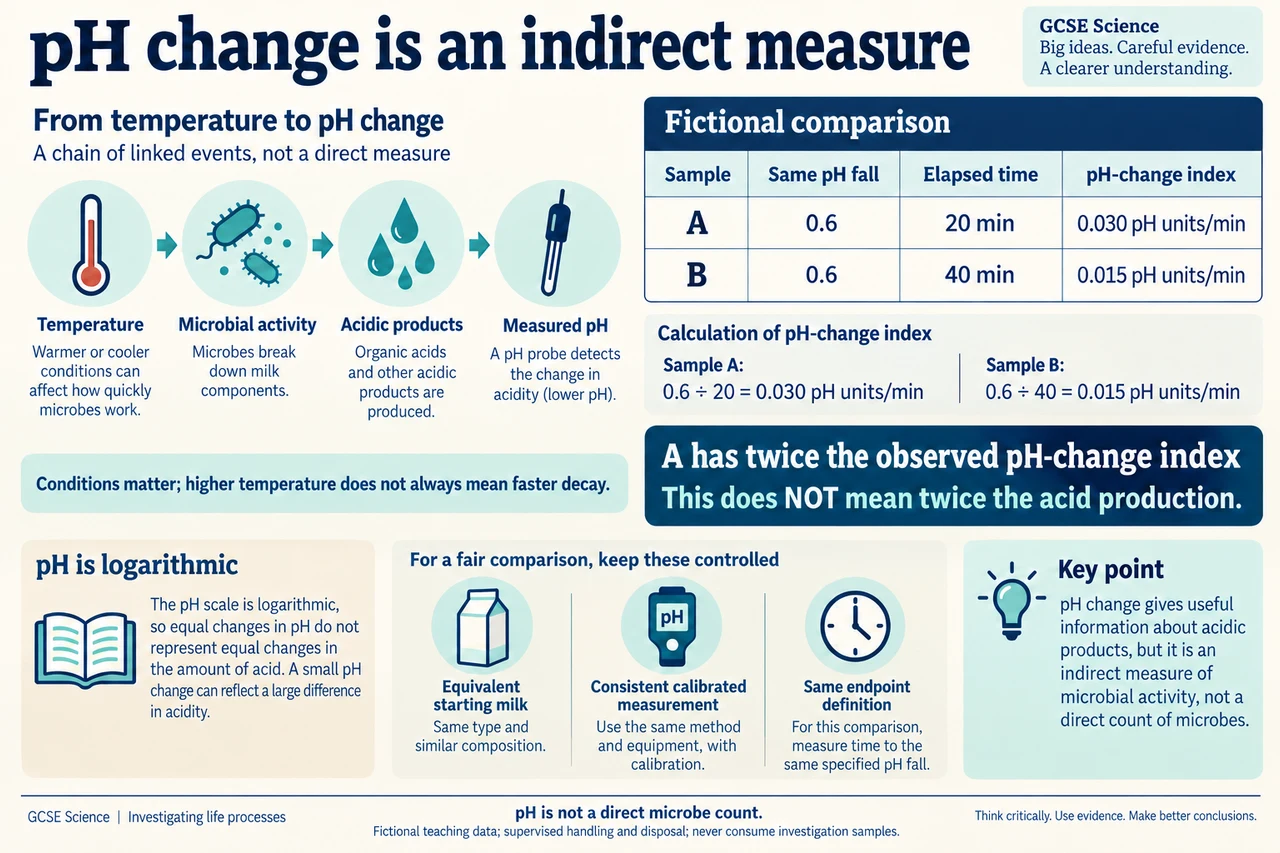
Original myAudience scientific illustration; not a documentary photograph or measured specimen. · Original generated project artwork; source concepts checked, no textbook figures copied.
Interpreting temperature effects on milk decay
This practical study compares temperature with fresh-milk decay using pH change as an observed outcome. Microbial activity can produce acidic substances, but pH is an indirect indicator rather than a direct count of microorganisms. Compare equivalent starting material, elapsed time and measurement methods. This lesson analyses supplied fictional results; it does not give a home microbial-growth procedure.
Temperature can affect enzyme-mediated activity and microbial growth within a suitable range; very high temperatures may impair activity rather than increase it indefinitely. pH measurements require calibration and consistent technique. Repeats reveal variation, while a probe offset can introduce a systematic error across every reading. A no-change result might reflect limited observation time or resolution, so interpret it under the stated conditions.
An absolute pH change divided by time can describe an observed rate index, but pH is logarithmic and that index is not the same as acid concentration produced per minute. Comparing the time to the same specified pH endpoint is another defined measure. Use the same definition for every comparison. Food samples used in investigations must not be consumed; handling and disposal follow the school’s supervised risk assessment.
Worked example: Two fictional samples each fall by 0.6 pH units; A takes 20 min and B takes 40 min. Compare observed indices.
A: 0.6 / 20 = 0.030 pH units/min.
B: 0.6 / 40 = 0.015 pH units/min.
Answer: A has twice the observed pH-change index. This is not proof of twice the acid production, because pH is logarithmic.
Check your understanding: Does a pH-change index directly measure the mass of acid produced?
Answer: No.
Why: pH is a logarithmic chemical measure, so interpreting acid production requires additional information.