Building and breaking biological chains
By UK A Level Biology · independent study · myAudience
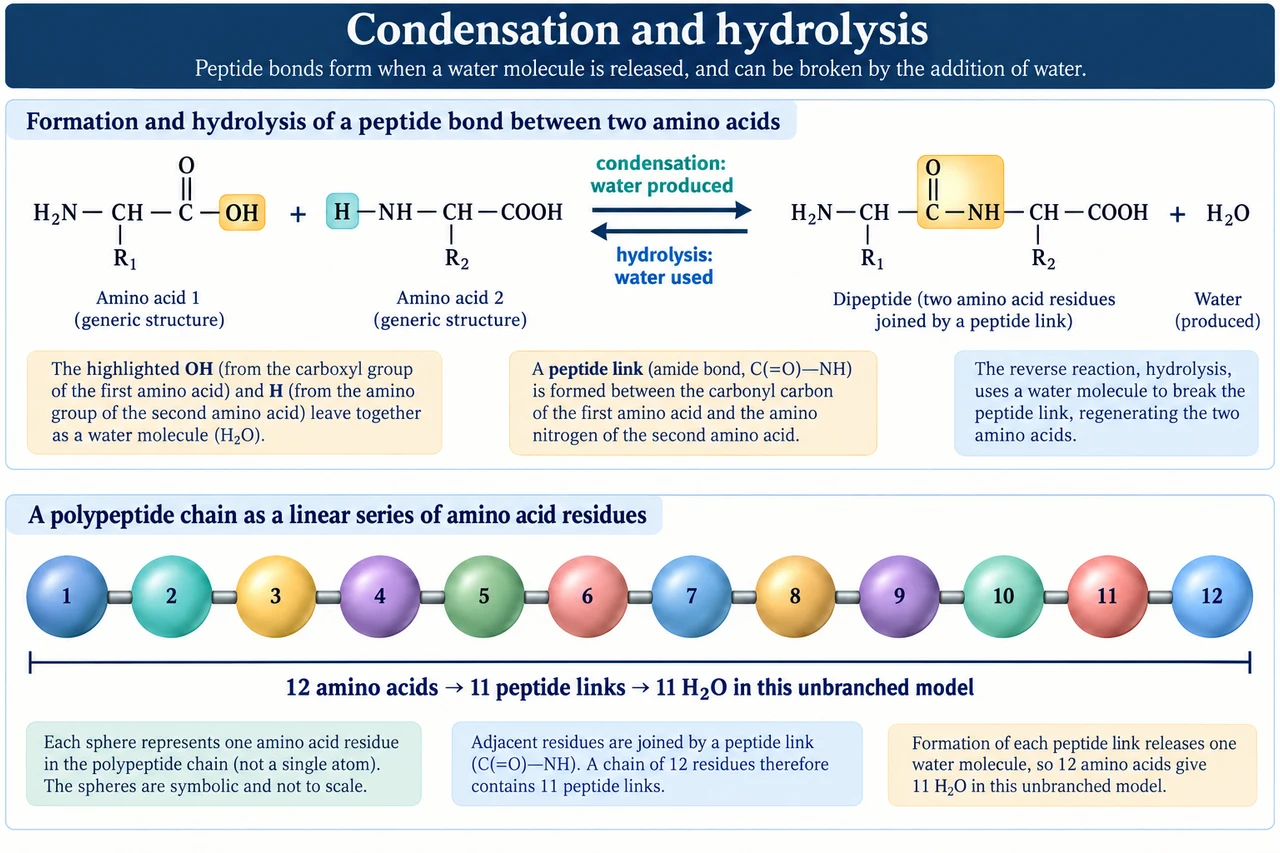
Original myAudience scientific illustration; not a documentary photograph or measured specimen. · Original generated project artwork; no source textbook figures reused. Sources support scientific review, not copied-art licensing.
Building and breaking biological chains
A large molecule can be assembled from smaller units. Amino acids join into polypeptides; nucleotides join into nucleic acids. A polymer contains many linked units, but a large biological molecule is not automatically a polymer: triglycerides are a useful counterexample.
Condensation creates a linkage while producing water. Hydrolysis uses water when a linkage is split. Count bonds rather than units when calculating water molecules for a single unbranched chain; the first unit has no preceding bond.
The identities of the linked units matter as well as their number. A protein chain has amino-acid side chains that influence folding, whereas a nucleotide chain has a base sequence that can carry instructions. Polymer is therefore a structural category, not a claim that all long chains have the same function or the same type of bond.
When investigating a reaction, distinguish a molecular explanation from a test result. A colour change in an assay can support the presence of a substance under the test’s conditions, but does not automatically identify every molecule in a mixture. Controls and a consistent method help make comparisons interpretable.
For a single unbranched chain of n units, there are n − 1 links. The arithmetic describes a stated molecular model, not every complex branched structure. Formation and breaking of bonds involve energy changes, so condensation and hydrolysis identify reaction chemistry rather than proving that all joining reactions release energy. Triglycerides are assembled by condensation but are not chains of repeating monomers in the usual polymer sense.
Worked example: Twelve amino acids form one unbranched polypeptide. How many water molecules are produced?
A chain of twelve units contains eleven links.
Each peptide-link formation produces one water molecule.
Answer: 11 water molecules.
Check your understanding: What reaction splits a peptide linkage using water?
Answer: Hydrolysis.
Why: Water is a reactant in hydrolysis; condensation instead produces water while joining units.