Why carbohydrate structure matters
By UK A Level Biology · independent study · myAudience
Original myAudience scientific illustration; not a documentary photograph or measured specimen. · Original generated project artwork; no source textbook figures reused. Sources support scientific review, not copied-art licensing.
Why carbohydrate structure matters
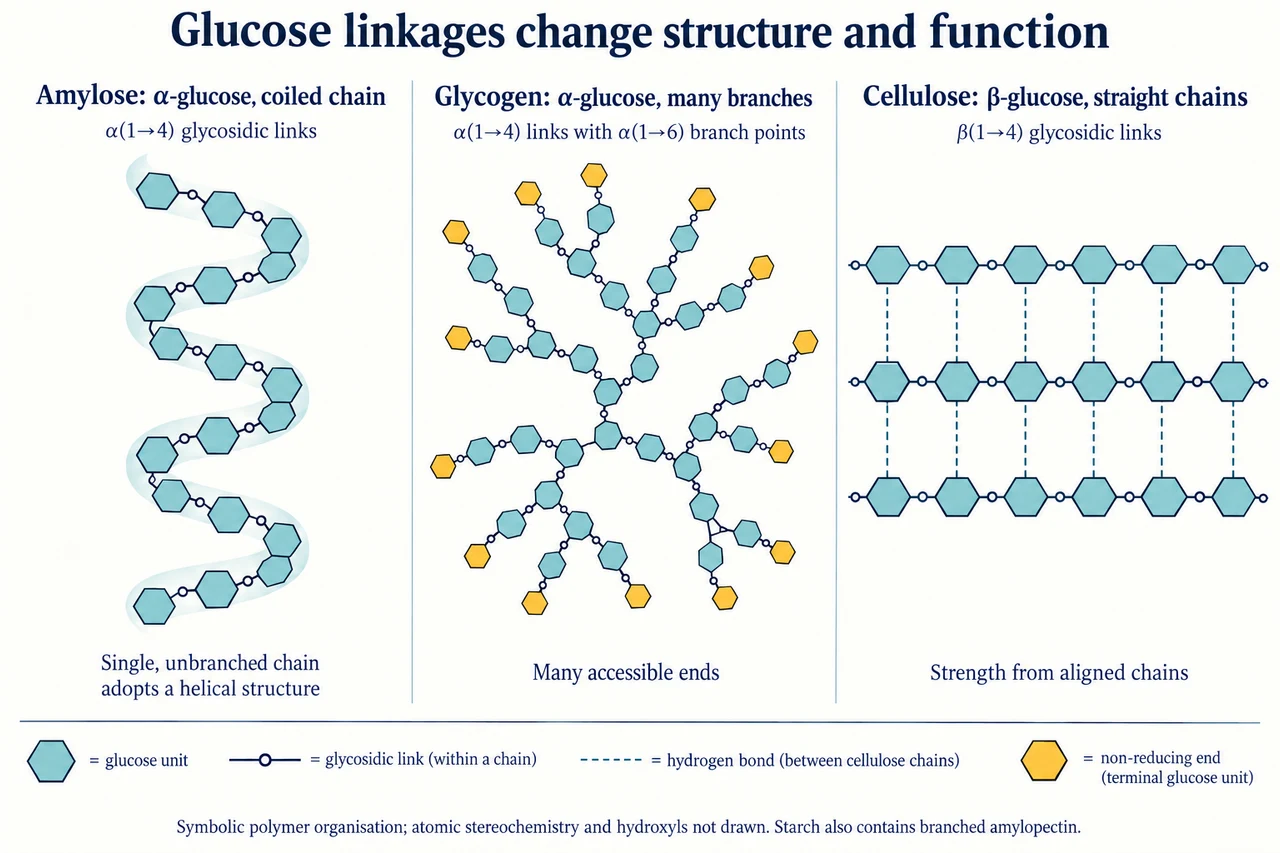
Monosaccharides can join through glycosidic bonds. Maltose contains two glucose units, while sucrose combines glucose and fructose. Larger glucose-based molecules differ in their linkages and branching, so the same small building block can support different jobs.
Starch and glycogen store carbohydrate in compact forms. Cellulose forms straight chains that associate into strong fibres. Compare the orientation of groups in alpha- and beta-glucose diagrams before predicting the bonds they make; similar molecular formulas do not guarantee similar properties.
In alpha- and beta-glucose, the arrangement around one carbon differs. That seemingly small difference affects how glucose units can be joined into larger structures. Cellulose chains associate through many hydrogen bonds between chains; their collective arrangement helps explain strength even though an individual interaction is relatively weak.
A compact storage molecule also avoids the osmotic consequences of keeping the same supply as many separate soluble glucose molecules. Branching provides accessible ends, while insolubility reduces direct effects on water potential. Structure, access and storage therefore contribute different parts of the functional explanation.
Maltose joins glucose with glucose, sucrose joins glucose with fructose, and lactose joins glucose with galactose. Starch includes coiled and branched components; glycogen is highly branched, while cellulose uses β-glucose linkages in straight chains. Qualitative tests distinguish reducing sugar, non-reducing sugar after appropriate prior treatment, and starch under supervised conditions; a negative reducing-sugar result alone does not show that no carbohydrate exists.
Worked example: A diagram shows glucose chains with many branch ends. Explain one benefit for storage.
Enzymes can act at accessible chain ends.
More ends permit several reactions at once when glucose is needed.
Answer: Branching can support rapid release of stored glucose.
Check your understanding: Why is cellulose useful in plant cell walls?
Answer: Its linked chains associate into strong fibres.
Why: The arrangement of chains provides mechanical support rather than simply acting as a soluble sugar store.