Two lipid structures, different jobs
By UK A Level Biology · independent study · myAudience
Original myAudience scientific illustration; not a documentary photograph or measured specimen. · Original generated project artwork; no source textbook figures reused. Sources support scientific review, not copied-art licensing.
Two lipid structures, different jobs
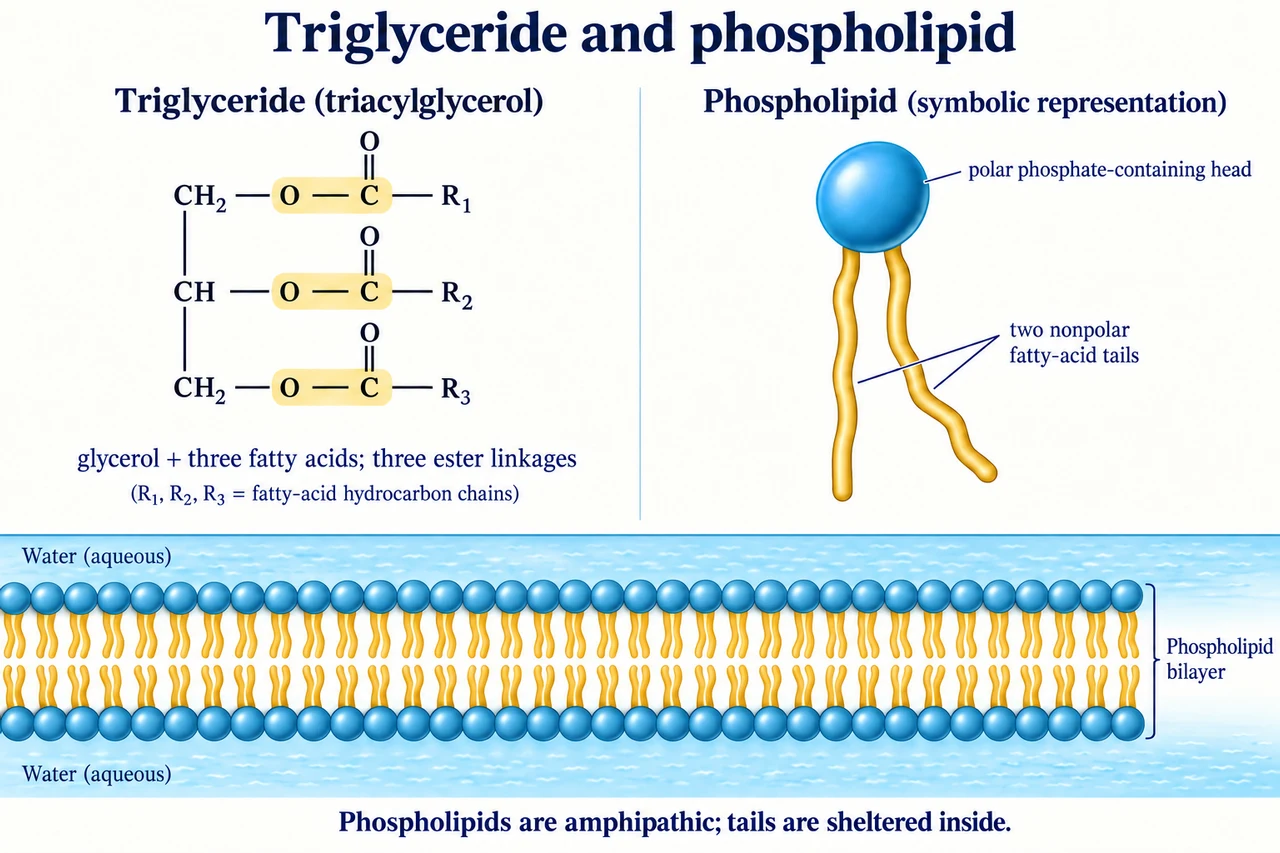
A triglyceride joins glycerol to three fatty acids through ester linkages. Its largely nonpolar structure makes it poorly soluble in water. Phospholipids have a polar phosphate-containing region and two nonpolar fatty-acid tails, giving one molecule two different interactions with water.
In water, phospholipids can arrange with heads facing the watery surroundings and tails sheltered inside a bilayer. A double bond in an unsaturated fatty-acid chain can introduce a bend; compare structures rather than assuming all fats have identical physical properties.
A saturated fatty-acid chain has no carbon–carbon double bonds. A cis double bond changes the chain’s geometry and can affect packing. Compare this specific structure with the vague label unsaturated: the number and arrangement of double bonds matter, and physical behaviour is not explained by the word fat alone.
Hydrophobic tails do not actively choose the centre of a membrane. Their arrangement follows interactions among the molecules and water. Membrane proteins then provide functions the lipid bilayer cannot supply alone, including selective transport and signalling. A bilayer is a boundary with embedded machinery rather than a rigid wall.
Ester-bond formation links each fatty acid to glycerol, giving three such links in a triglyceride. In the common school phospholipid model, two fatty-acid tails coexist with a phosphate-containing polar region. A membrane bilayer exposes heads to water on both surfaces while shielding tails inside. The emulsion test is a qualitative indication of lipids under approved conditions, not a measurement of whether a food is nutritionally appropriate for an individual.
Worked example: How many ester linkages join one glycerol to three fatty acids in a triglyceride?
Each fatty acid attaches through one ester linkage.
Three attachments therefore form three links.
Answer: 3 ester linkages.
Check your understanding: Which phospholipid region faces water in a bilayer?
Answer: The polar head.
Why: The nonpolar tails are sheltered from water within the bilayer.