Reading DNA and RNA structures
By UK A Level Biology · independent study · myAudience
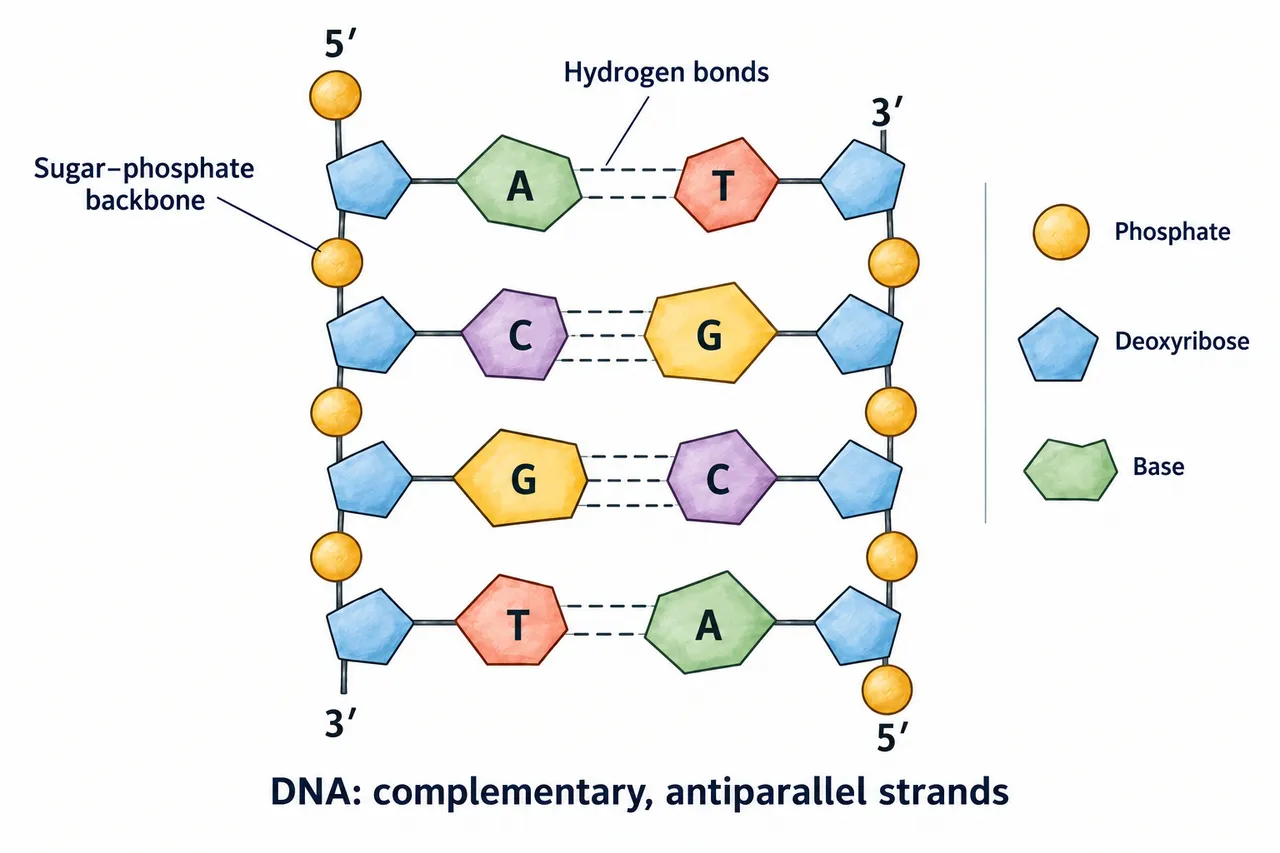
Original AI-generated myAudience scientific concept illustration; not a micrograph or measured specimen. · Original generated project artwork; no source textbook figures reused. Reference links support subject review, not a copied-art license.
Reading DNA and RNA structures
A nucleotide contains a sugar, phosphate and nitrogenous base. DNA uses deoxyribose and usually forms two complementary antiparallel strands. RNA uses ribose and uracil instead of thymine; RNA molecules can fold and take several roles, including carrying messages and contributing to ribosomes.
Phosphodiester bonds run along each strand. Hydrogen bonds connect complementary DNA bases across strands. Keep these linkages separate when explaining stability or replication: splitting base pairs is not the same as cutting a strand backbone.
Complementarity depends on base-pair interactions, while antiparallel describes opposite strand orientations. These are separate properties. A sequence written in one direction must be paired with a strand running in the other; reversing the direction labels without adjusting the sequence can create a misleading diagram.
The sequence is information carried along a chemically repeated backbone. This helps explain how very different instructions can be stored without needing a different backbone chemistry for every gene. RNA can also act structurally or catalytically, so calling all RNA a temporary messenger misses several important roles.
In double-stranded DNA, A pairs with T through two hydrogen bonds and C with G through three in the standard model. The covalent phosphodiester backbone is a different kind of linkage. If A is 24% of all bases in the double-stranded sample, T is 24% and C and G are each 26%; the same calculation is not guaranteed for an isolated single strand. RNA uses uracil and ribose and can have roles beyond carrying a message.
Worked example: Double-stranded DNA contains 24% adenine. Find its cytosine percentage.
Thymine also makes up 24%.
A and T total 48%, leaving 52% for G and C.
Split the remaining percentage equally.
Answer: 26% cytosine.
Check your understanding: Which sugar occurs in RNA?
Answer: Ribose.
Why: DNA contains deoxyribose; confusing the sugars hides a structural difference between the molecules.