Copying DNA with templates
By UK A Level Biology · independent study · myAudience
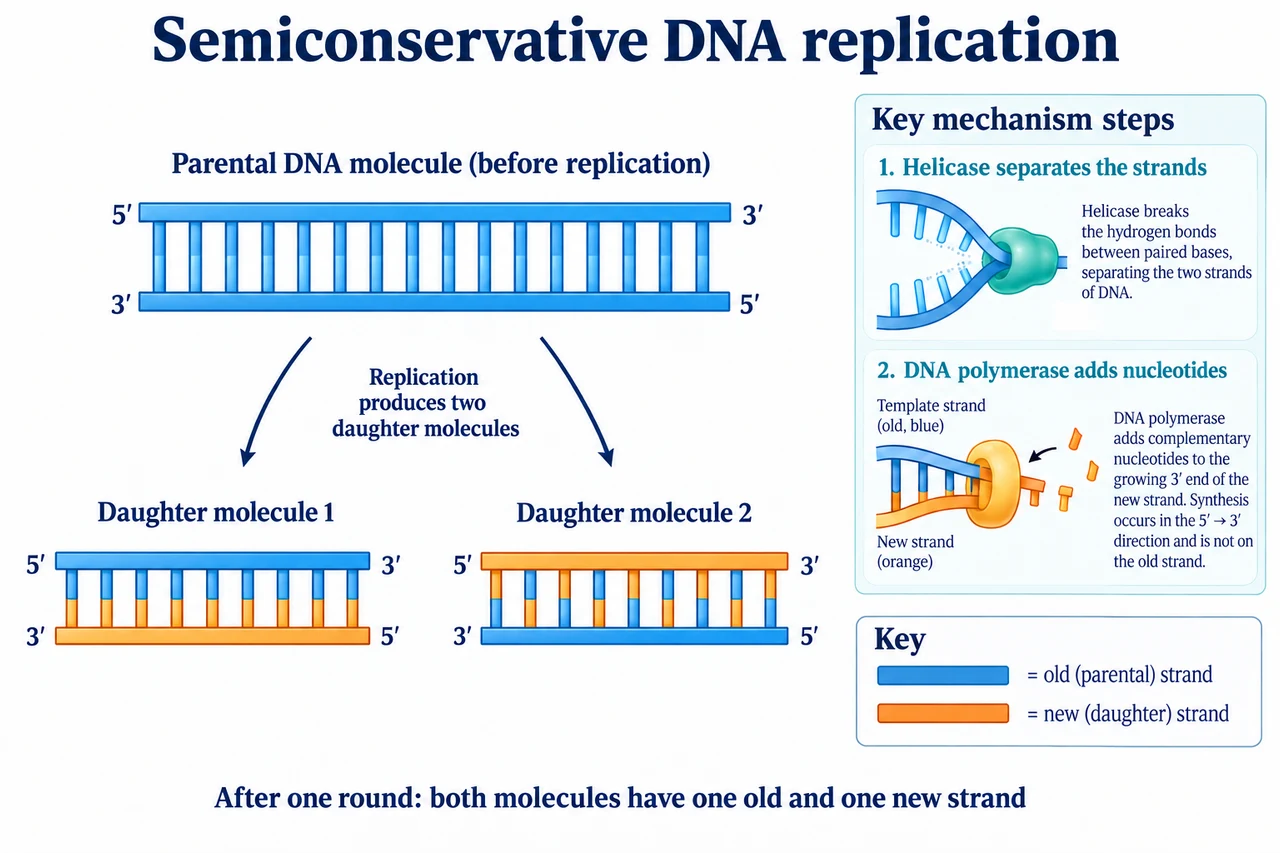
Original myAudience scientific illustration; not a documentary photograph or measured specimen. · Original generated project artwork; no source textbook figures reused. Sources support scientific review, not copied-art licensing.
Copying DNA with templates
Before a cell divides, its DNA is copied. The strands separate and each supplies a template for a complementary new strand. DNA polymerase joins suitable nucleotides along the growing strand, producing molecules that each retain one parental strand.
This is semiconservative replication. A model must explain experimental evidence, not only resemble a double helix. Isotope-labelling results can distinguish molecules with old and new material; compare the predictions of competing models before selecting one.
Replication requires strand separation and extension using a complementary template. DNA polymerase extends a growing strand in a particular direction; a diagram must show orientation rather than merely draw two matching lines. The concept of semiconservative copying concerns which strands persist, while enzyme roles explain how copying occurs.
Experimental models are judged by predictions. After one labelled-to-unlabelled copying round, a hybrid result can reject a simple fully conservative prediction, but another round supplies additional discrimination between alternatives. Evidence becomes stronger when the model predicts an observation before the result is examined.
Helicase separates paired strands by disrupting hydrogen-bond interactions; polymerase supports formation of a new covalent backbone using the complementary template. After two rounds in a simplified labelled-to-unlabelled experiment, half the molecules remain hybrid and half have two unlabelled strands. That distribution discriminates semiconservative copying from models that predict all material stays intermixed in every molecule. Strand ancestry and the enzyme mechanism explain different aspects of replication.
Worked example: A labelled parental DNA molecule replicates once using unlabelled nucleotides. Describe its two products.
Each old strand serves as a template.
Each product receives one old strand and one newly made strand.
Answer: Both DNA molecules contain one labelled and one unlabelled strand.
Check your understanding: What does semiconservative describe?
Answer: Retention of one parental strand in each copied DNA molecule.
Why: It refers to strand composition, not retention of half the genes.