ATP couples cellular reactions
By UK A Level Biology · independent study · myAudience
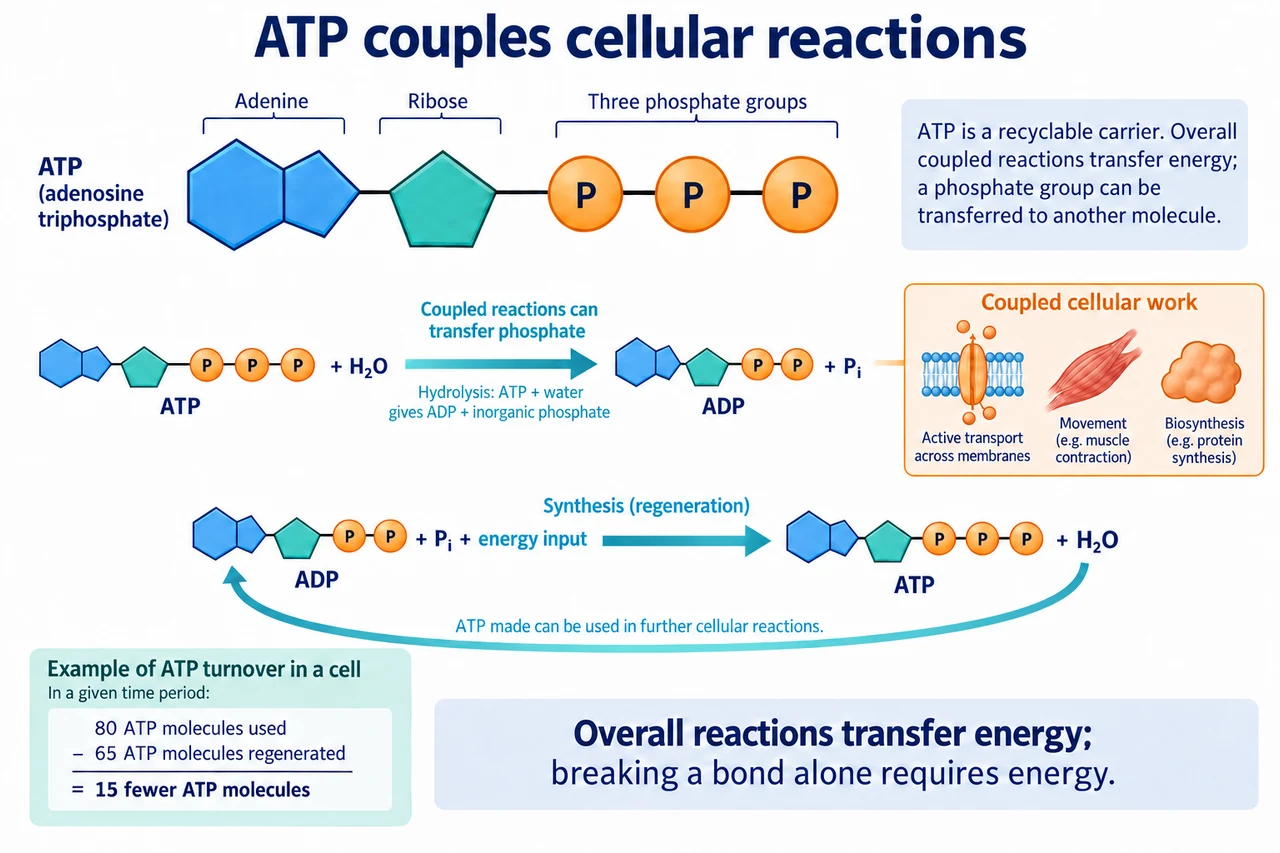
Original myAudience scientific illustration; not a documentary photograph or measured specimen. · Original generated project artwork; no source textbook figures reused. Sources support scientific review, not copied-art licensing.
ATP couples cellular reactions
ATP contains adenine, ribose and three phosphate groups. Hydrolysis can be coupled to cellular processes requiring an energy transfer, including transport and movement. Cells regenerate ATP from ADP and phosphate using energy supplied by respiration or photosynthesis.
ATP is a rapidly recycled carrier, rather than the main long-term energy store. Do not say that breaking a bond by itself releases energy: the overall reaction, including formation of new interactions in the products, has the relevant energy change.
ATP can transfer a phosphate group to another molecule, altering its reactivity in a coupled process. Coupling means that the combined sequence can proceed even when one isolated step would not be favourable. It is more informative than treating ATP as a tiny packet of material energy that simply vanishes.
ATP synthesis needs an energy source and appropriate machinery. In mitochondria and chloroplasts, proton gradients can support ATP synthase activity. ATP links those energy-transfer pathways to many local processes, but this does not mean all ATP is made by one pathway or that every energy transfer directly consumes ATP.
ATP hydrolysis produces ADP and inorganic phosphate through enzyme-mediated reactions. Coupling or phosphate transfer can make another cellular process favourable; hydrolysis considered alone is not a universal explanation of how every process is driven. Regeneration requires an energy input and appropriate catalysts. The example pool decreases by 15 when 80 molecules are used and 65 regenerated; the total used is not the same as the net change.
Worked example: A process hydrolyses 80 ATP molecules and the cell regenerates 65 in the same interval. Find the net ATP change.
Subtract molecules regenerated from molecules hydrolysed.
80 - 65 = 15.
Answer: The ATP pool decreases by 15 molecules.
Check your understanding: Why must ATP be regenerated continually?
Answer: It is used repeatedly in coupled cellular processes.
Why: A small recyclable carrier pool supports ongoing transfers without acting as a permanent energy reserve.