Water makes a biological environment
By UK A Level Biology · independent study · myAudience
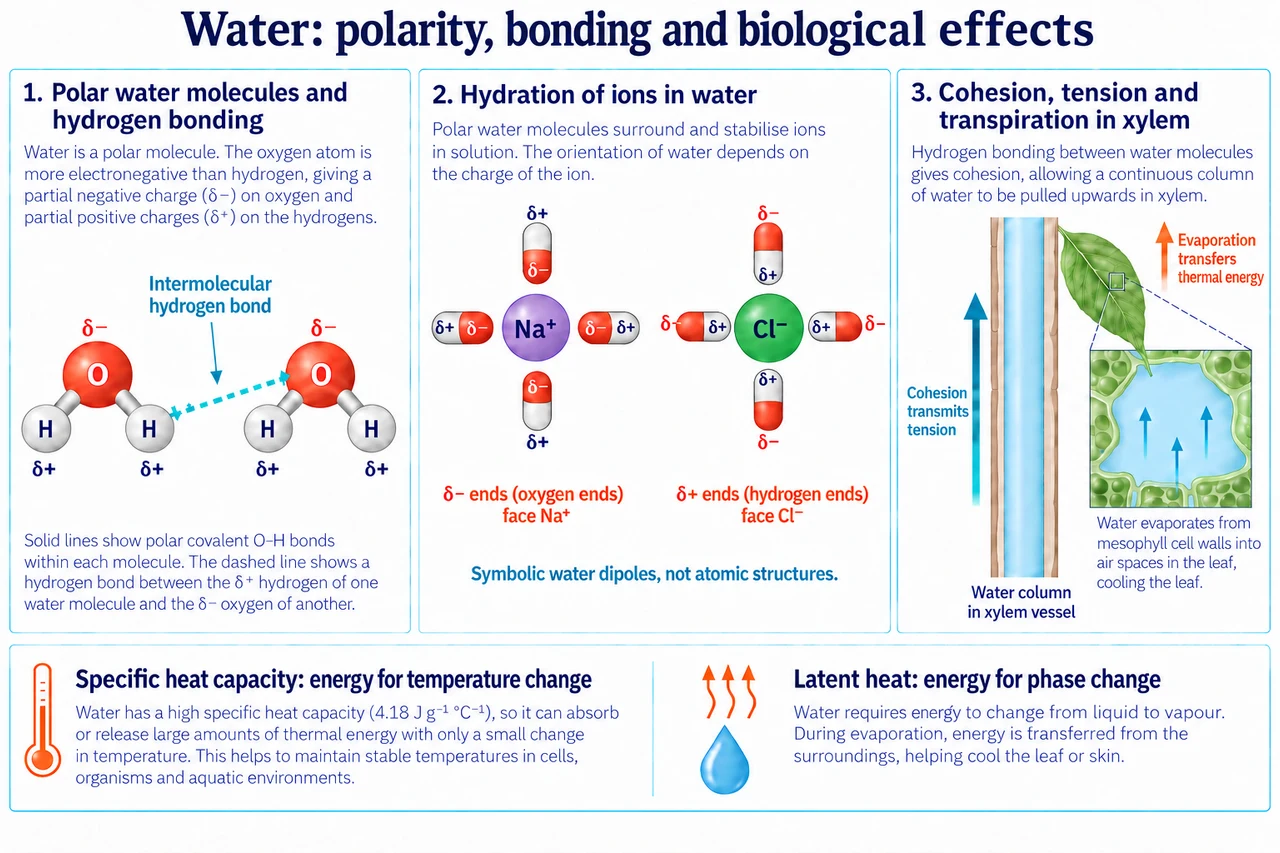
Original myAudience scientific illustration; not a documentary photograph or measured specimen. · Original generated project artwork; no source textbook figures reused. Sources support scientific review, not copied-art licensing.
Water makes a biological environment
Water molecules are polar and form hydrogen bonds with one another. Their interactions help explain why water dissolves many charged substances and resists rapid temperature changes. Dissolving a substance is different from reacting with it.
Water also participates in reactions and supports transport. Cohesion helps water remain in continuous columns, while evaporation transfers thermal energy away from a surface. Match a property to a mechanism before describing its biological benefit.
Water’s polarity helps stabilise dissolved ions by interactions around them. Nonpolar substances behave differently, which is important for membrane organisation. Solvent behaviour is therefore selective: saying water dissolves everything would erase the very property that allows an aqueous environment and a lipid boundary to coexist.
A high latent heat of vaporisation means that evaporation can remove substantial thermal energy. A high specific heat capacity concerns temperature change without the same phase change. Both involve energy transfers, but they answer different questions; specify whether water is warming or evaporating before selecting the explanation.
Water participates in reactions as well as providing a medium: hydrolysis consumes water, while condensation commonly produces it in the school reaction models. Its polar structure supports interactions with ions and hydrogen bonding among water molecules. Cohesion explains attraction between water molecules; surface tension concerns the interface with air. Neither property means every dissolved substance behaves identically or that water movement through a plant needs no external energy source.
Worked example: Explain why a large body of water can change temperature more slowly than nearby land.
A temperature rise requires a transfer of thermal energy.
Water has a relatively high specific heat capacity.
Answer: A given mass of water requires a comparatively large energy transfer for each degree of warming.
Check your understanding: Which property helps maintain a connected water column in xylem?
Answer: Cohesion.
Why: Attraction between water molecules helps a column transmit tension.