Ions have specific cellular roles
By UK A Level Biology · independent study · myAudience
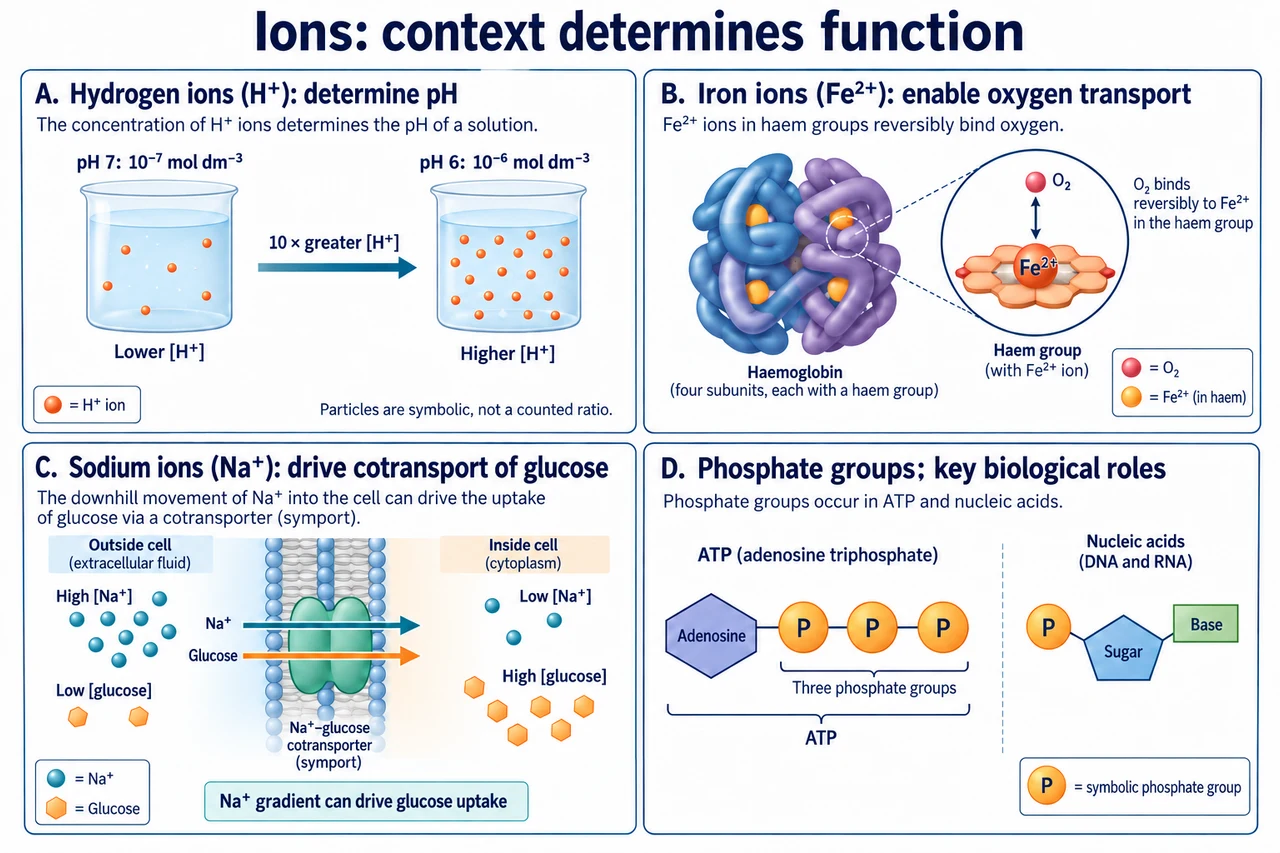
Original myAudience scientific illustration; not a documentary photograph or measured specimen. · Original generated project artwork; no source textbook figures reused. Sources support scientific review, not copied-art licensing.
Ions have specific cellular roles
An ion carries electrical charge, which affects its interactions with water and biological molecules. Sodium gradients help drive transport, phosphate is part of nucleotides, and iron in haem groups contributes to oxygen binding. A small concentration can still have a substantial role.
Hydrogen-ion concentration is related to pH logarithmically. A change of one pH unit represents a tenfold concentration change. Use the stated concentration and units; pH is not a simple percentage of acidity.
An ion’s role depends on charge, concentration and molecular context. Iron within a haem group is not equivalent to any free iron ion in solution. Likewise, phosphate in a nucleotide is part of a larger structure. Name the biological setting rather than listing ions as though their presence guarantees the same function everywhere.
A gradient stores a difference across a boundary. Sodium movement can be coupled to another transport process, while hydrogen-ion changes affect the protonation of biological molecules. Concentration differences matter alongside absolute concentrations, helping explain why cells regulate both composition and distribution.
Sodium can move down its electrochemical gradient through a cotransporter while supporting glucose movement against its own gradient. Phosphate is part of ATP and nucleic-acid structure; iron is associated with haemoglobin’s haem groups. For an ideal concentration comparison, pH = −log₁₀[H⁺], with concentration expressed consistently. Moving from pH 7 to pH 6 means ten times the hydrogen-ion concentration, not a 1% increase.
Worked example: A solution changes from pH 7 to pH 6. Compare hydrogen-ion concentrations.
Lower pH means higher hydrogen-ion concentration.
One pH unit corresponds to a factor of ten.
Answer: The hydrogen-ion concentration increases tenfold.
Check your understanding: Where does phosphate occur in ATP?
Answer: In its phosphate groups.
Why: ATP contains three phosphate groups, not three iron ions.