Cell compartments divide the work
By UK A Level Biology · independent study · myAudience
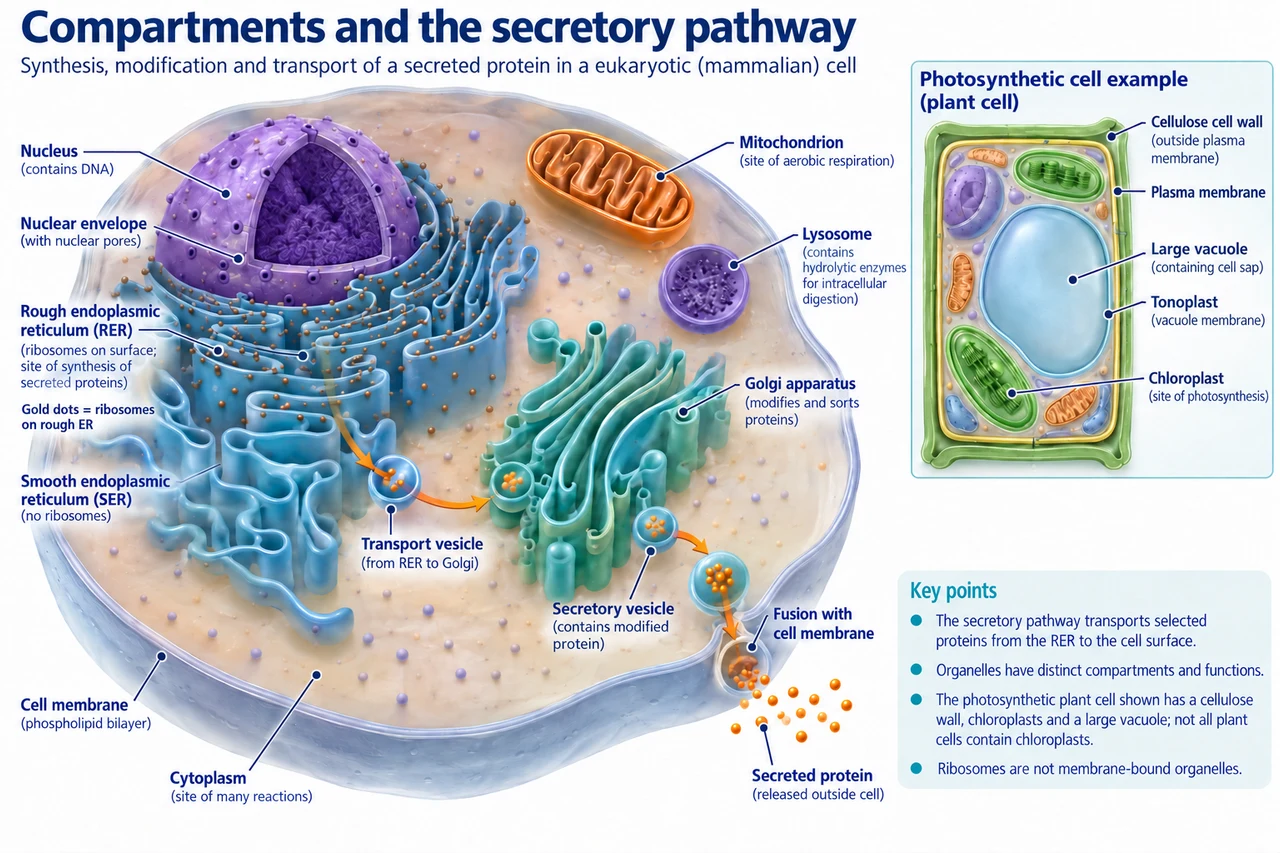
Original myAudience scientific illustration; not a documentary photograph or measured specimen. · Original generated project artwork; no source textbook figures reused. Sources support scientific review, not copied-art licensing.
Cell compartments divide the work
A eukaryotic cell contains membrane-bound compartments. The nucleus houses much of its DNA; mitochondria support aerobic energy transfer. Ribosomes build polypeptides, rough endoplasmic reticulum helps process some of them, and the Golgi apparatus modifies and sorts transported products.
Plant cells also have features such as a cellulose wall and, in photosynthetic tissues, chloroplasts. Link each structure to its job without assuming that every plant cell has every organelle. A root cell need not photosynthesise.
Rough ER bears ribosomes and handles particular protein products; smooth ER has roles including lipid-related processes. Golgi vesicles carry sorted material, while lysosomes contain hydrolytic enzymes within a membrane. A plant vacuole holds cell sap and contributes to turgor; its surrounding membrane is distinct from the cell-surface membrane and wall. Fungal walls are not simply plant cellulose walls. These distinctions prevent a compartment label from becoming a claim that every cell contains the same structures.
Worked example: A cell secretes substantial amounts of protein. Suggest two structures likely to be prominent.
Secreted proteins are made on ribosomes associated with rough ER.
They are processed and sorted through the Golgi pathway.
Answer: Rough endoplasmic reticulum and Golgi apparatus.
Check your understanding: Are ribosomes surrounded by their own membrane?
Answer: No.
Why: They contain RNA and protein but are not membrane-bound organelles.