Bacteria are cells; viruses are particles
By UK A Level Biology · independent study · myAudience
Original myAudience scientific illustration; not a documentary photograph or measured specimen. · Original generated project artwork; no source textbook figures reused. Sources support scientific review, not copied-art licensing.
Bacteria are cells; viruses are particles
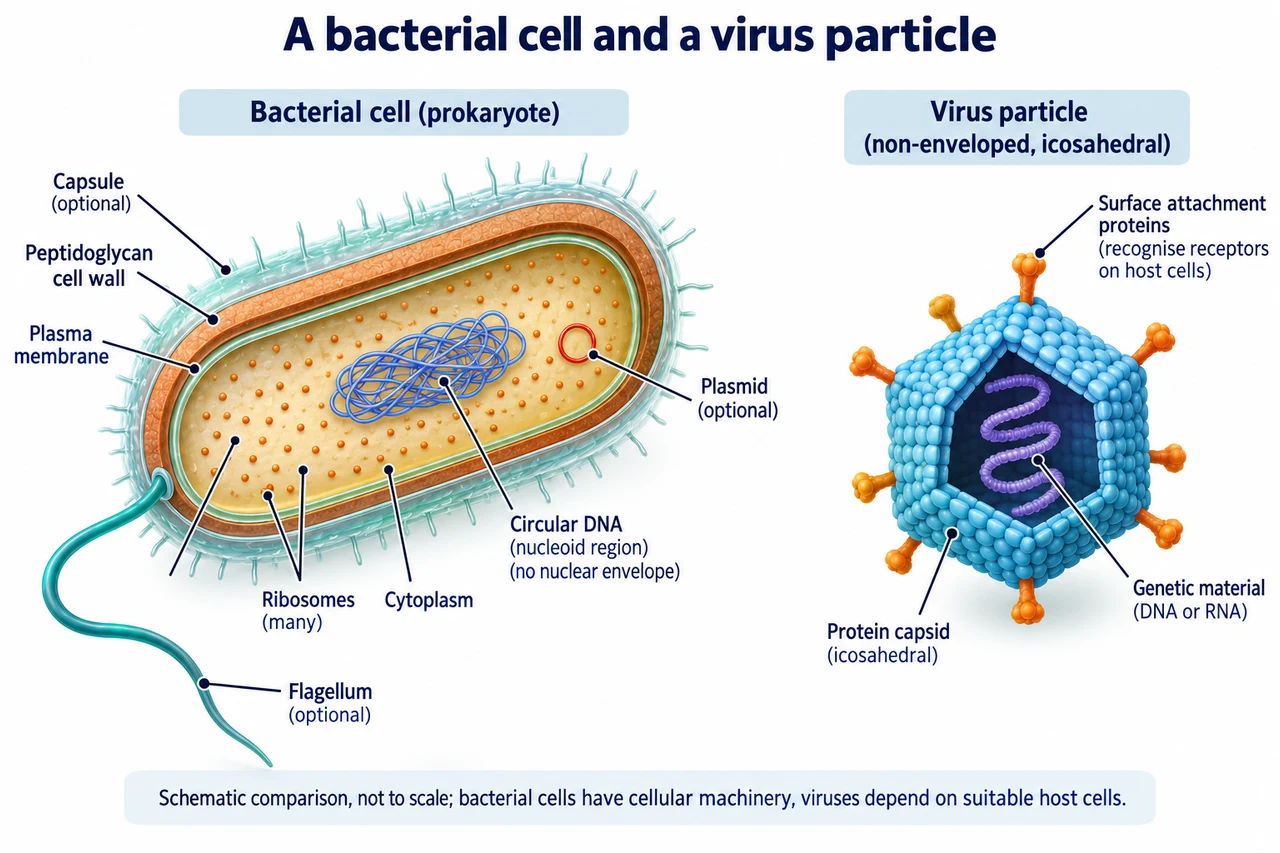
Bacteria have cell membranes, cytoplasm and ribosomes but no membrane-bound nucleus. Many contain a circular chromosome and may carry plasmids. Their cell walls and other surface structures differ from those of plants and animals.
A virus has genetic material enclosed in a protein capsid, sometimes with an additional envelope. It does not have the cellular machinery needed for independent reproduction. Comparing a virus with a bacterial cell helps explain why treatments do not act on both in the same way.
In the bacterial model, peptidoglycan provides wall structure; optional capsules and flagella affect particular interactions or movement. Viral attachment proteins recognise compatible host-cell features, linking structure to host specificity. A virus may use DNA or RNA as genetic material; a capsid is a protein coat rather than a cell wall. The statement that a virus depends on cells concerns reproduction machinery, not a claim that its genetic information is absent.
Worked example: A particle contains RNA and a capsid but no ribosomes. Can it build its own proteins independently?
Protein synthesis requires ribosomes and additional cellular machinery.
The described particle lacks that machinery.
Answer: No; it must use suitable host-cell machinery.
Check your understanding: Does a bacterium lack DNA because it lacks a nucleus?
Answer: No.
Why: Its genetic material is present without a membrane-bound nuclear compartment.