Making cells without changing the chromosome count
By UK A Level Biology · independent study · myAudience
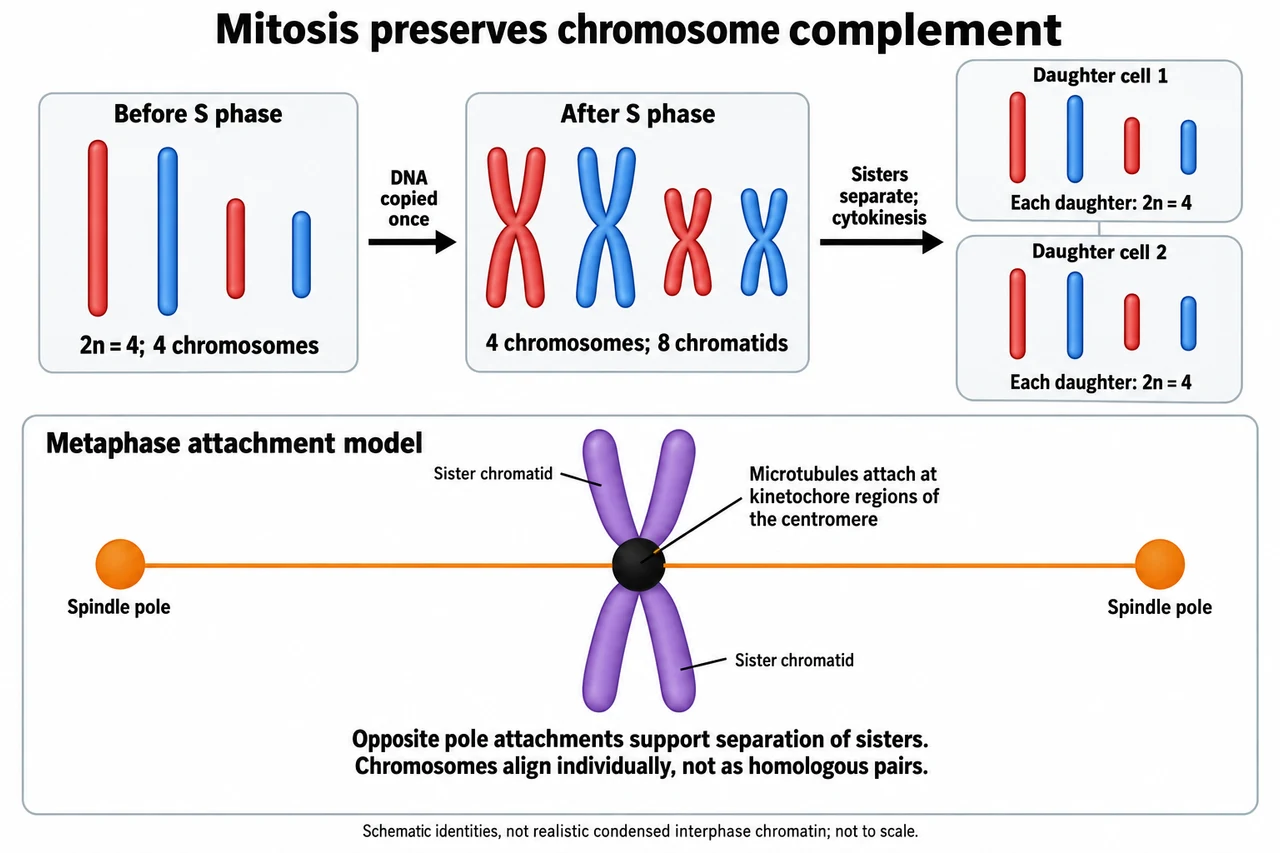
Original myAudience scientific illustration; not a documentary photograph or measured specimen. · Original generated project artwork; no source textbook figures reused. Sources support scientific review, not copied-art licensing.
Making cells without changing the chromosome count
A cell cycle includes growth, DNA replication and division. During mitosis, copied chromosomes are distributed so daughter nuclei normally receive the same chromosome complement. Cytokinesis divides the cell contents; it is distinct from division of the nucleus.
Count chromosomes using centromeres, rather than counting every replicated chromatid as a separate chromosome. Bacteria divide by binary fission without a mitotic spindle. Viruses reproduce through host processes rather than by ordinary cell division.
In prophase chromosomes condense; at metaphase they align at the spindle’s equator, at anaphase sister chromatids separate, and telophase accompanies formation of new nuclei. Cytokinesis divides the cytoplasm. A mitotic index is dividing cells divided by all cells counted, so 18 dividing among 120 gives 0.15 or 15%. It samples the observed population, not an exact duration without additional assumptions about cycling and sampling. Binary fission separates bacterial copies without these eukaryotic mitotic phases.
Worked example: An organism has 8 chromosomes in a body-cell nucleus. After DNA replication, count chromosomes and chromatids before separation.
Each chromosome has replicated into two chromatids.
The centromere-based chromosome count remains 8.
Answer: 8 chromosomes and 16 chromatids.
Check your understanding: Does mitosis normally halve chromosome number?
Answer: No.
Why: Mitosis preserves the chromosome complement; meiosis has a reduction division.