Membranes control traffic
By UK A Level Biology · independent study · myAudience
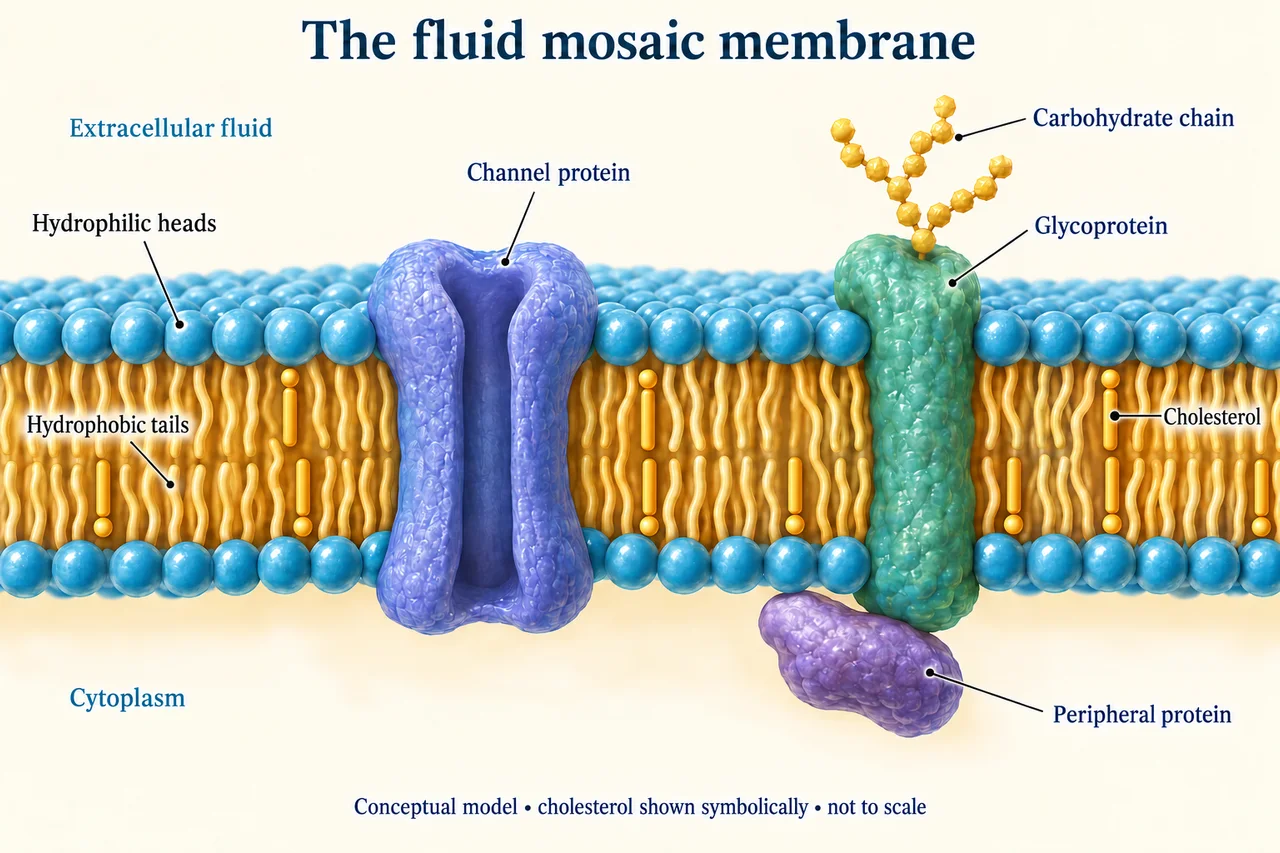
Original AI-generated myAudience scientific concept illustration; not a micrograph or measured specimen. · Original generated project artwork; no source textbook figures reused. Reference links support subject review, not a copied-art license.
Membranes control traffic
A phospholipid bilayer forms a selective boundary containing proteins. Small nonpolar molecules can cross directly; some other substances use channels or carriers. Diffusion and facilitated diffusion have net movement down a gradient and do not directly require ATP hydrolysis.
Active transport uses an energy supply to move substances against a gradient. Osmosis concerns water moving across a selectively permeable membrane along a water-potential gradient. Co-transport can use one substance moving down its gradient to drive another across.
The fluid-mosaic model includes mobile lipids, embedded proteins and carbohydrate-bearing components involved in recognition. Cholesterol affects movement and stability in membranes where it occurs. Water moves from higher to lower water potential across a suitable membrane: −150 kPa is higher than −400 kPa. Surface area and transporter abundance affect capacity, but selectivity, the driving gradient and substrate availability also matter. A leakier membrane is not necessarily a better-regulated membrane.
Worked example: Water potentials are -150 kPa outside a cell and -400 kPa inside. Predict initial net water movement.
-150 kPa is the higher water potential.
Water moves toward the lower water potential across a suitable membrane.
Answer: Into the cell.
Check your understanding: Is facilitated diffusion a form of active transport?
Answer: No.
Why: A transport protein is involved, but net movement is down a gradient without direct ATP use.