Recognition, defence and immune memory
By UK A Level Biology · independent study · myAudience
Original myAudience scientific illustration; not a documentary photograph or measured specimen. · Original generated project artwork; no source textbook figures reused. Sources support scientific review, not copied-art licensing.
Recognition, defence and immune memory
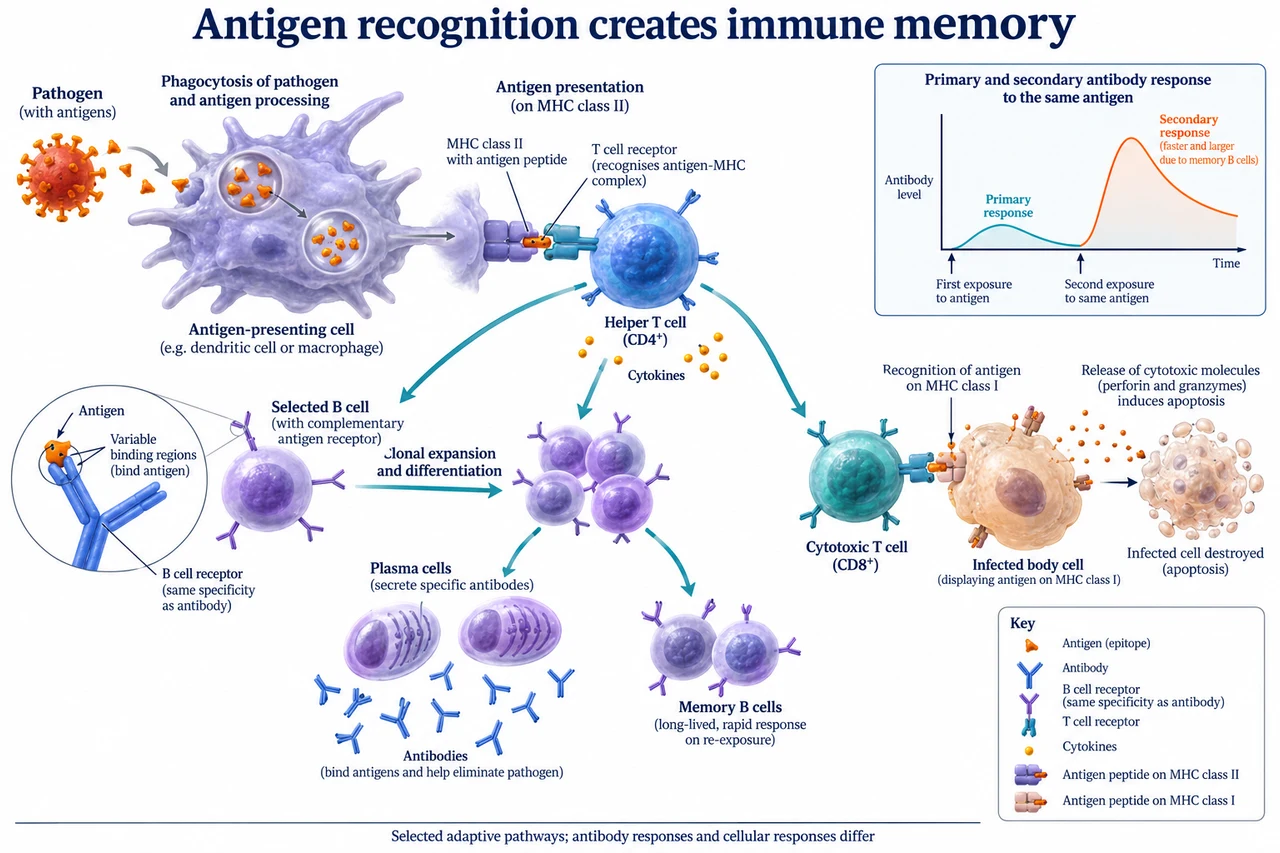
Cells display surface molecules that can be recognised by immune cells. Phagocytes engulf material; antigen presentation helps coordinate specific responses. B lymphocytes can develop into antibody-secreting cells, while T lymphocytes have roles including coordination and destruction of infected cells.
Antibodies bind particular molecular features rather than every possible pathogen. Some activated lymphocytes become memory cells, supporting a faster response on later exposure. Vaccination uses this principle; individual outcomes still depend on the vaccine, pathogen and person.
Helper T-cell activation coordinates responses including B-cell expansion; selected B cells form antibody-secreting plasma cells and memory cells. Antibodies have variable binding regions and can support agglutination or phagocytosis. Active immunity involves the recipient’s own response, while passive immunity supplies antibodies without creating the same memory. HIV infects helper T cells and can impair coordinated defence. An ELISA uses specific binding plus an enzyme-related signal; positive and negative controls are essential because a colour signal alone does not establish an infallible diagnosis.
Worked example: An antibody binds antigen A but not antigen B. Explain the difference without saying the antibody chooses.
The binding site has particular chemical and structural properties.
A complementary feature of A fits those interactions better than B.
Answer: Binding depends on molecular complementarity, not conscious recognition.
Check your understanding: Why can a later response to the same antigen be faster?
Answer: Specific memory cells already exist.
Why: They can respond and expand without repeating every stage of the first response.