Size changes the exchange problem
By UK A Level Biology · independent study · myAudience
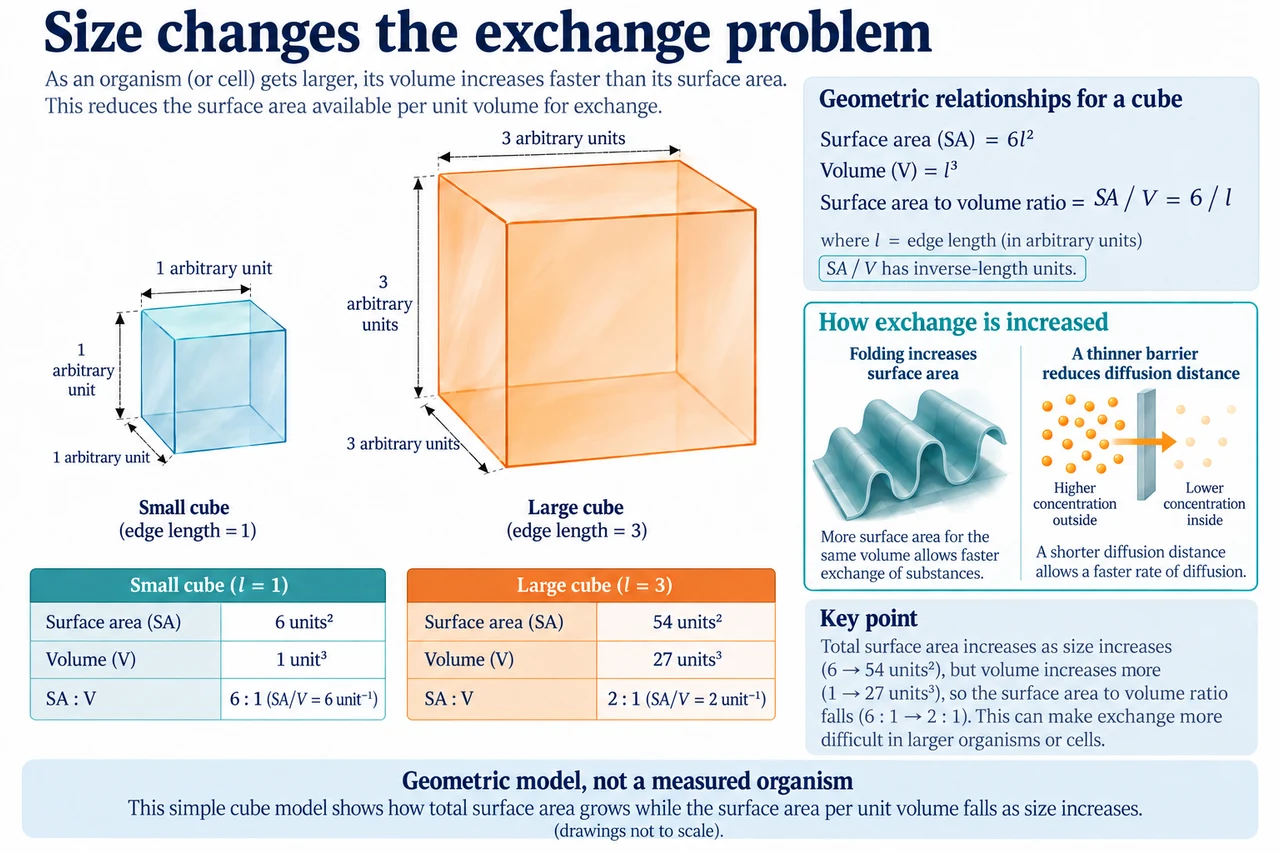
Original myAudience scientific illustration; not a documentary photograph or measured specimen. · Original generated project artwork; no source textbook figures reused. Sources support scientific review, not copied-art licensing.
Size changes the exchange problem
As a similarly shaped organism becomes larger, volume increases faster than external surface area. A lower surface-area-to-volume ratio means less outer surface is available per unit of living material. Shape, metabolic demand and diffusion distance all affect the exchange problem.
Exchange surfaces and transport systems can compensate. Thin barriers reduce diffusion distance, while folded surfaces provide more area. Bulk flow moves material over longer distances; diffusion still completes the final crossing between nearby regions.
For a cube with side l, surface area is 6l² and volume is l³, giving 6/l. Doubling side length halves that surface-area-to-volume ratio; it does not imply half the total surface area, which rises fourfold. Thin or folded structures can change the geometric problem, while transport maintains gradients over distance. A model comparison must state shape and units rather than applying a cube equation to an irregular organism as an exact measurement.
Worked example: Compare cubes with side lengths 1 and 3 arbitrary units.
For a cube, area = 6l² and volume = l³.
Ratios are 6/1 and 54/27.
Answer: The ratios are 6:1 and 2:1; the larger cube has less surface per unit volume.
Check your understanding: Why does doubling a cube side not double its volume?
Answer: Volume depends on the cube of its side length.
Why: Doubling length gives eight times the volume but only four times the area.