Keeping respiratory gases moving
By UK A Level Biology · independent study · myAudience
Original myAudience scientific illustration; not a documentary photograph or measured specimen. · Original generated project artwork; no source textbook figures reused. Sources support scientific review, not copied-art licensing.
Keeping respiratory gases moving
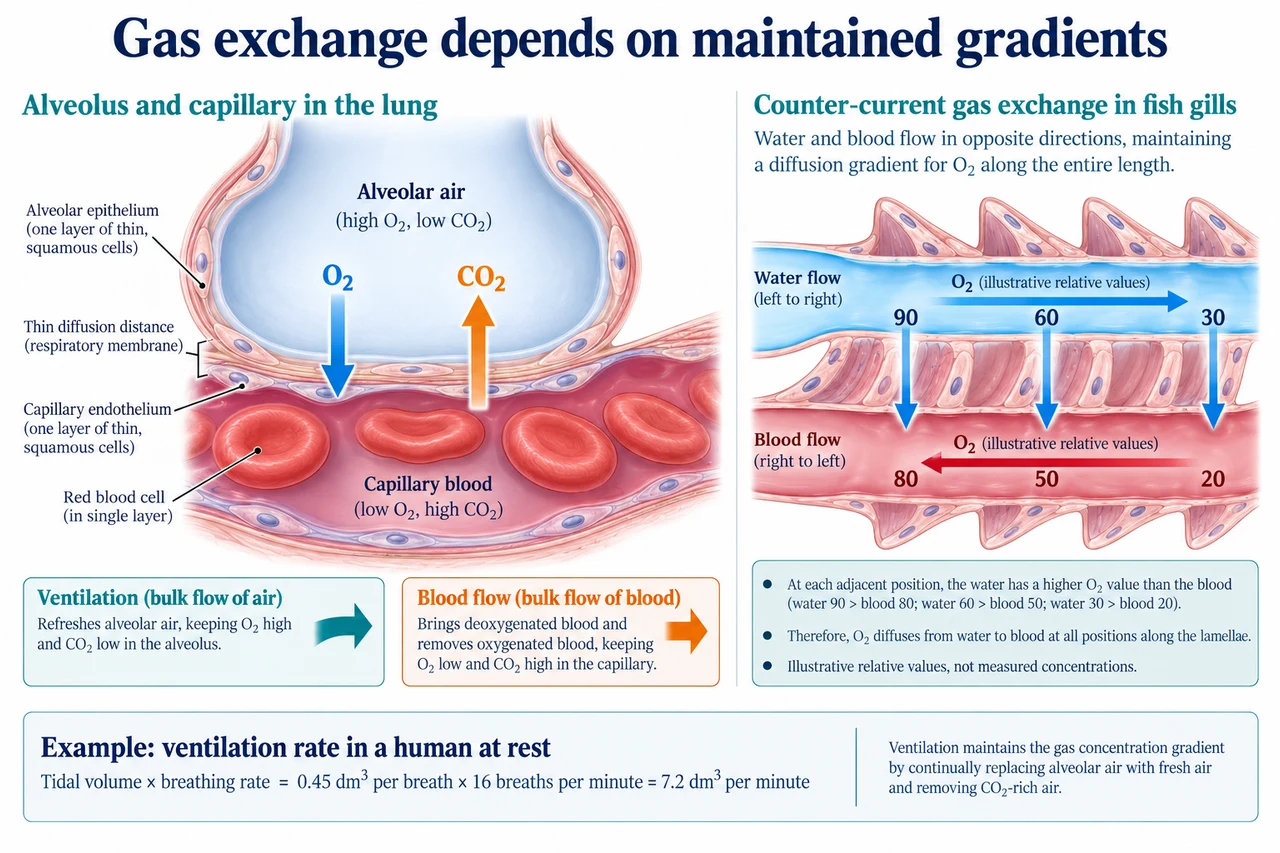
Gas exchange requires a suitable gradient across a thin surface. Alveoli provide a large area close to blood; ventilation and circulation renew the surrounding gases. Fish gills use opposing water and blood flows, allowing a gradient to persist along an exchange surface.
Insects transport air through branching tubes, while leaves exchange gases through stomata and internal air spaces. Efficient exchange can also increase water loss on land. An adaptation must be evaluated against both benefits and costs.
During inspiration, diaphragm contraction and appropriate external intercostal action increase thoracic volume and lower pressure relative to outside air. Air then enters; it is not pulled in because alveoli actively grab oxygen. Forced expiration uses different muscle actions. In fish, countercurrent flow maintains a diffusion gradient along gill lamellae. Terrestrial insects regulate spiracles, while xerophytic leaves can reduce water loss through traits such as reduced exposed area or sheltered stomata. Gas-exchange efficiency and water conservation can conflict.
Worked example: Tidal volume is 0.45 dm³ and breathing rate is 16 breaths per minute. Calculate ventilation per minute.
Multiply volume per breath by breaths per minute.
0.45 × 16 = 7.2.
Answer: 7.2 dm³ per minute.
Check your understanding: Why does countercurrent flow help fish gills?
Answer: It helps maintain an oxygen gradient along the exchange surface.
Why: Water can have a higher oxygen concentration than adjacent blood at successive points, allowing continued diffusion.